By GLP-1 Journal Editorial Team — Updated February 26, 2026
You’ve tried the Mediterranean diet. Keto. Intermittent fasting. Weight Watchers. That diet your friend used to lose 8 kg in a month.
They all work. For a while.
Then the weight comes back. Always. Often with a few extra pounds as a “return gift.”
And the blame — they tell you — is yours. Lack of willpower. Lack of discipline. “You didn’t try hard enough.”
No. The fault lies with the system. With an approach that ignores your body’s biology and asks you to fight a battle you can’t win.
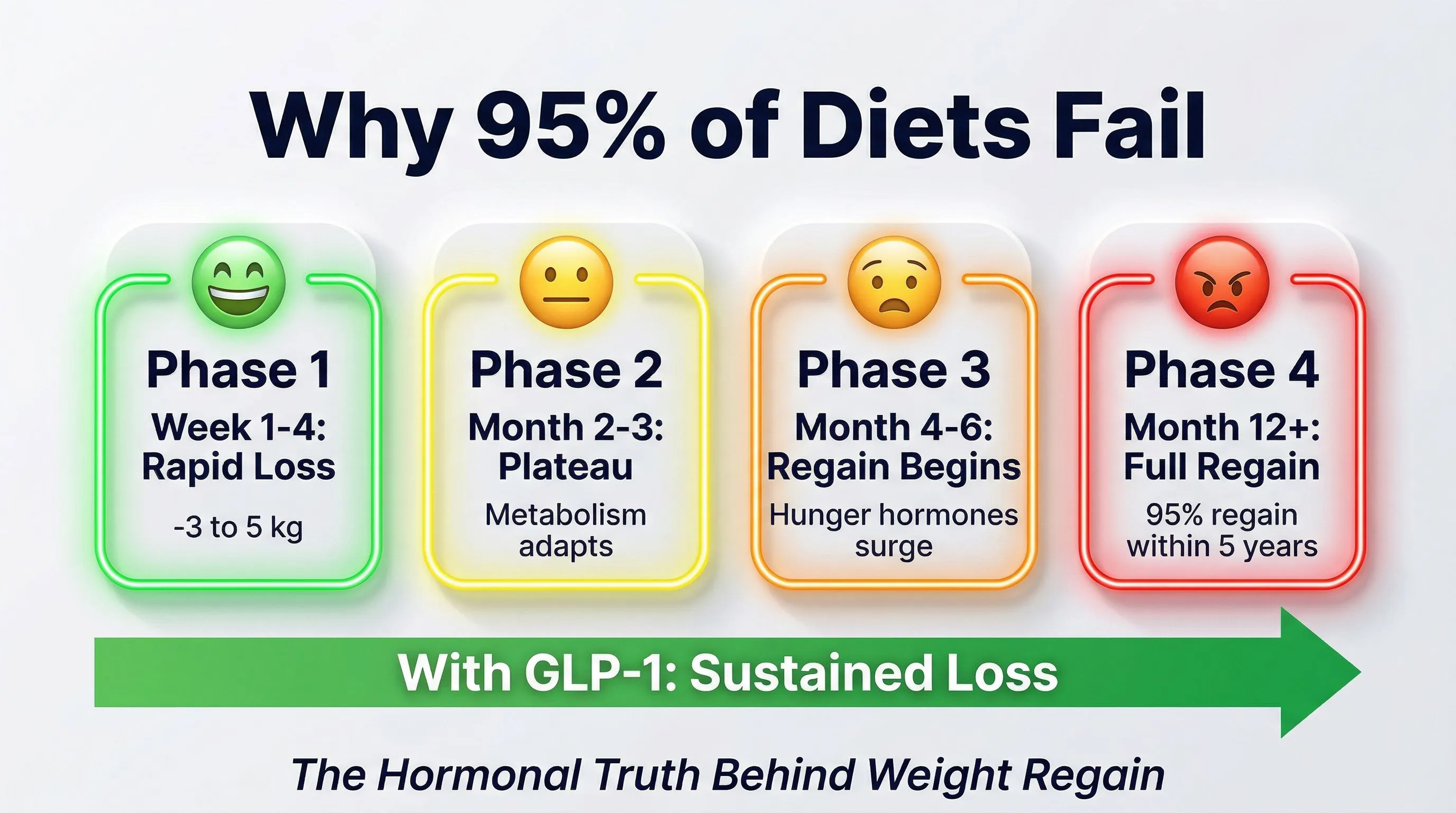
The numbers are merciless: 95% of diets fail within 5 years. Not 50%. Not 70%. Ninety-five percent.
It’s not possible that 95% of people are lazy or lack willpower. The problem lies elsewhere. And science knows exactly where.
Table of Contents
- The Number: 95% Failure
- Reason 1: Food Noise Won’t Turn Off
- Reason 2: Metabolic Adaptation
- Reason 3: You Lose Muscle, Not Just Fat
- Reason 4: Willpower Is a Limited Resource
- Reason 5: Leptin Betrays You
- Reason 6: The Microbiome Resists
- Reason 7: The Mental “All or Nothing”
- The Graveyard of Solutions
- What Actually Works
- The Third Way: Turning Off the Noise
- Frequently Asked Questions
- Related Articles
- References
The Number: 95% Failure
The 95% diet failure statistic has been repeated so many times that you might think it’s exaggerated. It’s not.
Meta-analyses of studies on dietary programs show that average weight loss is maintained for 6-12 months. After that point, weight begins to climb back. Within 3-5 years, most people have returned to their starting weight or surpassed it.
This doesn’t depend on the specific diet. Ketogenic, low-calorie, low-fat, high-protein — all work in the short term. All fail in the long term with similar percentages.
Why? Because they all make the same mistake: they reduce calories without addressing the biological mechanisms that regulate hunger, satiety, and fat storage.
It’s like emptying a bathtub with the faucet on. You can empty it for a while — with enormous effort — but the water keeps flowing in. Until you turn off the faucet.
Reason 1: Food Noise Won’t Turn Off
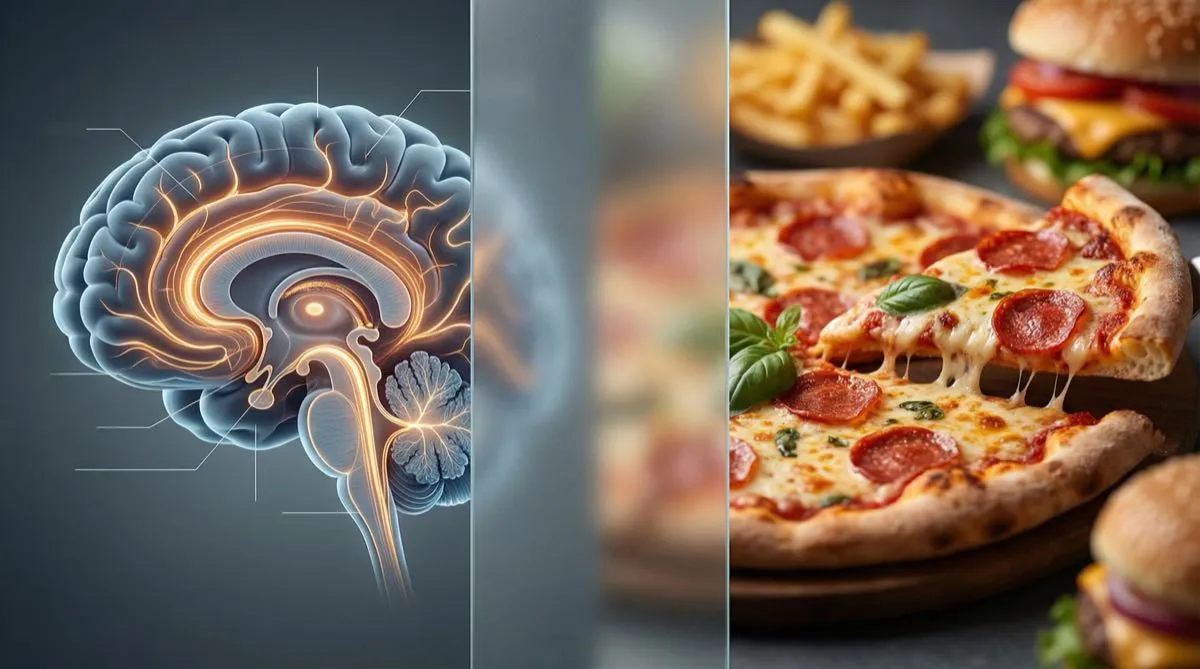
The first and most powerful reason diets fail is Food Noise — that constant internal dialogue telling you to eat even when you’re not hungry.
Diets tell you WHAT to eat and HOW MUCH. No diet explains HOW to stop thinking about food.
When you’re dieting, Food Noise doesn’t decrease. It increases. Your brain interprets restriction as a potential famine and turns up the volume of the “seek food” signal. It’s a survival mechanism — perfect for a world where food was scarce, disastrous in a world where it’s everywhere.
The study by Blundell et al. (Diabetes, Obesity and Metabolism, 2017) demonstrated that only GLP-1 modulation effectively reduces food preoccupation. Diets alone don’t — in fact, they amplify it.
Every evening on a diet is a battle against a noise that never gets tired. You do.
Reason 2: Metabolic Adaptation
Your body isn’t stupid. When you give it less food, it doesn’t keep burning at the same rate. It adapts. It consumes less. We discuss this in detail in the guide on how metabolism works and why it stalls.
This is called metabolic adaptation (or adaptive thermogenesis) and was documented spectacularly by the study on “The Biggest Loser” contestants.
What happens:
- You reduce calories to 1,200/day
- The body reduces basal metabolism
- After a few weeks, 1,200 calories are no longer enough to lose weight
- You reduce to 1,000 — and the body adapts again
- When you go back to eating normally (1,800-2,000), your metabolism is still at 1,200
- Result: you regain everything, faster than before
The body learns from restriction. And each subsequent diet teaches the body to adapt faster. That’s why the fifth diet works worse than the first.
Reason 3: You Lose Muscle, Not Just Fat
When you eat less without adequate protein intake, your body doesn’t burn just fat. It burns muscle too.
The problem: muscle is exactly what keeps metabolism high. Each kg of muscle burns about 50 calories per day at rest. Losing 3 kg of muscle = 150 fewer calories burned every day. Forever. Or at least until you rebuild that muscle — which is much harder than losing it.
Drastic diets (under 1,000 calories, no protein, zero physical activity) are the worst for this. You lose weight on the scale — 40% of it could be muscle.
When you regain weight after the diet, you regain almost all of it as fat. The net result: you weigh the same as before, but with less muscle and more fat. Body composition has worsened.
The solution: 1.5-2g of protein per kg of body weight per day. Every day. During any weight loss protocol. It’s not optional.
Reason 4: Willpower Is a Limited Resource
The fitness industry sells you the idea that weight loss is a matter of character. Discipline. Willpower.
Science says otherwise: willpower is a limited cognitive resource. It’s called decision fatigue — and it gets worse with every decision you make during the day.
In the morning you’re strong. You eat well. You make the right choices.
At 9:00 PM, after a day of work, decisions, stress, kids — your reserve is empty. And the Food Noise is still there. Fresh. Tireless.
The chocolate wins. Always. Not because you’re weak — because you’re fighting a biological system with a resource that runs out.
Any diet that depends on daily discipline has an expiration date. That date is when your willpower can no longer contain the noise.
Reason 5: Leptin Betrays You
Leptin is the long-term satiety hormone. Produced by fat tissue, it tells the brain: “We have sufficient reserves. No need to seek more food.”
When you lose fat, you produce less leptin. The brain interprets this as: “Reserves are running low. EMERGENCY. Seek food.” It’s the same mechanism that explains why you can’t lose weight despite every effort.
The result:
- Appetite increases
- Food Noise amplifies
- Metabolism slows down
- Specific cravings for high-calorie foods
Your body is actively sabotaging the diet. Not out of malice — for survival. The brain doesn’t know you’re trying to fit into that dress. It only knows that fat reserves are dropping and interprets the situation as potentially dangerous.
This leptin response can last months or years after weight loss. It’s one of the main reasons weight comes back.
Reason 6: The Microbiome Resists
Your gut hosts trillions of bacteria — the microbiome. And the microbiome influences how many calories you extract from food, what food you crave, and how your body stores energy.
Studies have shown that the microbiome of obese people is different from that of normal-weight people. It extracts more calories from the same food. It favors fat storage. It even influences food preferences — toward more calorie-dense foods.
When you go on a diet, your microbiome doesn’t change immediately. It continues to extract calories efficiently and send hunger signals to the brain. It can take months of different eating to significantly alter the microbiome’s composition.
Reason 7: The Mental “All or Nothing”
The seventh reason isn’t biological. It’s psychological. But it’s devastating.
“I’ll start the diet on Monday.” Monday works. Tuesday works. Wednesday you eat a piece of cake at a party. And the thought kicks in: “I’ve ruined everything. Might as well eat whatever I want until next Monday.”
The “all or nothing” thinking — the perception that a single transgression invalidates the entire journey — is the most silent killer of any diet. It turns a 300-calorie mistake into a 3,000-calorie binge.
Restrictive diets amplify this pattern because they create rigid rules (“NEVER carbs,” “NEVER sugar,” “NEVER after 6 PM”). The more rigid the rule, the more catastrophic the violation feels. And the more extreme the response.
The Graveyard of Solutions
Let’s tally up how much diet failure costs — in money and time.
| Solution | Annual Cost | Typical Result |
|---|---|---|
| Nutritionist | EUR 960-1,800 | Low-calorie diet, lose 3-4 kg, regain it all |
| Personal trainer | EUR 4,320-7,200 | Burn calories, body compensates, Food Noise intact |
| ”Fat burner” supplements | EUR 360-960 | No real effect on metabolism |
| Online programs | EUR 200-600 | Same pattern: restriction -> regain |
| Intermittent fasting | EUR 0 | Unsustainable for many, amplified Food Noise |
| Bariatric surgery | EUR 8,000-15,000 | Effective but invasive, irreversible, not for everyone |
Over a lifetime, a person struggling with weight spends an average of EUR 3,000-10,000 on solutions that don’t work. And loses years of emotional energy.
The problem isn’t the specific solution. It’s the approach: all of them treat the SYMPTOM (excess calories) without touching the CAUSE (dysregulated metabolic signals, Food Noise that won’t turn off).
What Actually Works
If traditional diets fail because they don’t address biology, what does work?
Principle 1: Turn Off the Noise Before Changing the Menu
Any meal plan is useless if Food Noise is at full volume. Turn off the noise first — then the plan works.
Principle 2: Protect the Muscle
Adequate protein (1.5-2g/kg/day) and resistance training. Non-negotiable. Without muscle, metabolism collapses and any weight lost returns faster.
Principle 3: Don’t Fight Biology — Modulate It
GLP-1 is a hormone your body already produces. Enhancing that signal isn’t fighting nature — it’s working with nature. Like putting on glasses when you can’t see well: you’re not changing your eyes, you’re amplifying a signal that’s too weak.
Principle 4: Build Habits in the Silence
The window when Food Noise is off is an opportunity. In that mental silence you can build eating and movement habits that were previously impossible — because the noise sabotaged them before they could become automatic.
Principle 5: Think Long-Term
Sustainable results are measured in months, not weeks. The TRIUMPH-4 trial measured results at 48 and 68 weeks. The -28.7% didn’t arrive in 30 days.
The Third Way: Turning Off the Noise
The weight loss world has been divided into two camps for decades:
Camp 1: “Eat less, move more.” Based on willpower. Fails 95% of the time.
Camp 2: “It’s not your fault, it’s genetics.” Removes responsibility. Offers no solutions.
There’s a third way. Based on the science of metabolic receptors.
The idea is simple: your body has biological switches — part of the incretin system — that regulate hunger, fat metabolism, and visceral fat. If these switches are dysregulated, no diet and no exercise program will work long-term.
Modulating these switches — through metabolic peptides — isn’t a shortcut. It’s the correction of a faulty biological signal.
First-generation peptides (semaglutide / Ozempic) proved that modulating GLP-1 works. -14.9% average. Food Noise turns off. For the first time, people can follow a meal plan without the constant sabotage of mental noise.
Third-generation peptides — retatrutide, which our editorial team calls TRIPLE-G after the three Gs of the GLP-1, GIP, and Glucagon receptors — go further. They activate all 3 metabolic switches simultaneously: satiety, fat metabolism, and visceral fat reduction.
The result in the TRIUMPH-4 trial (Jastreboff et al., NEJM 2023) on 5,800 people: -28.7%. Not because people were dieting. Because the noise was off, the metabolic signals were working, and habits could finally take root.
For those who wish to explore third-generation GLP-1 peptide protocols, with independent certificates of analysis and a free dosage calculator, fornitori europei specializzati is the European reference for the scientific community.
Frequently Asked Questions
Is it true that 95% of diets fail long-term?
Yes. Meta-analyses show that most people who lose weight on a diet regain it within 2-5 years, regardless of the type of diet. It doesn’t depend on the specific diet — ketogenic, low-calorie, low-fat all work in the short term but fail long-term because they reduce calories without addressing the biological mechanisms that regulate hunger and satiety.
Is metabolic adaptation reversible?
Partially. Each restrictive diet lowers basal metabolism and each successive cycle lowers it further. Rebuilding muscle mass with resistance training and maintaining adequate protein intake helps raise metabolism back up, but full recovery takes time and an intervention on deep hormonal signals.
Why isn't willpower enough to maintain weight?
Willpower is a limited cognitive resource that depletes over the course of the day (decision fatigue). Food Noise, on the other hand, is a constant biological signal that never gets tired. By evening, your capacity to resist is empty but the mental noise is still at full volume. That’s why dieters almost always give in during evening hours.
What happens to the body when I do too many yo-yo diets?
Each diet-regain cycle worsens the situation: basal metabolism drops further, the body learns to adapt faster to restriction, 25-40% of weight lost is muscle that gets rebuilt as fat, and Food Noise intensifies because the brain learns that “famines” keep coming back. We discuss this in detail in the guide on why you can’t lose weight.
Are there scientific tools for losing weight without fighting hunger?
Yes. GLP-1 agonist peptides amplify the natural satiety signal, turning off Food Noise at its source without creating the perception of “famine” that triggers metabolic adaptation. Clinical trials on thousands of people show weight losses from 15% to 29%. For those wanting to explore pharmaceutical-grade metabolic peptides with HPLC certification and verifiable COAs, fornitori europei specializzati offers educational resources and free shipping across Europe.
Related Articles
Spokes of This Pillar
- Yo-yo effect: why weight always comes back
- Metabolic adaptation: why each diet works less
- The diet that works is the one you don’t have to fight
- 5 weight loss beliefs that keep you stuck
- The hidden cost of failed diets
- Ketogenic diet: does it work long-term?
- Intermittent fasting: real pros and cons
- Why willpower isn’t enough for weight loss
- Nutritionist vs peptides: what actually works
- How to break the diet cycle
- Dieting after 40: why it’s different
- Leptin: the hormone that sabotages your diet
- Counting calories: does it really work?
- The discipline paradox in weight loss
- Microbiome and weight: the hidden connection
Cross-Pillar
- Food Noise: What It Is and How to Turn It Off
- Metabolism: How It Works and Why It Stalls
- Retatrutide (TRIPLE-G): The Complete Guide
- Ozempic (Semaglutide): Everything You Need to Know
- The 3 Metabolic Switches
References
- Blundell J, Finlayson G, Axelsen M, et al. “Effects of once-weekly semaglutide on appetite, energy intake, control of eating, food preference and body weight in subjects with obesity.” Diabetes, Obesity and Metabolism. 2017;19(9):1242-1251. DOI: 10.1111/dom.12932
- Wilding JPH, Batterham RL, Calanna S, et al. “Once-weekly semaglutide in adults with overweight or obesity.” New England Journal of Medicine. 2021;384(11):989-1002. DOI: 10.1056/NEJMoa2032183
- Jastreboff AM, Kaplan LM, Frías JP, et al. “Triple-hormone-receptor agonist retatrutide for obesity — a phase 2 trial.” New England Journal of Medicine. 2023;389(6):514-526. DOI: 10.1056/NEJMoa2301972
- Garvey WT, Batterham RL, Bhatt DL, et al. “Two-year effects of semaglutide in adults with overweight or obesity.” Nature Medicine. 2022;28:2083-2091. DOI: 10.1038/s41591-022-02026-4
- van Bloemendaal L, IJzerman RG, Ten Kulve JS, et al. “GLP-1 receptor activation modulates appetite- and reward-related brain areas in humans.” Diabetes. 2014;63(12):4186-4196. DOI: 10.2337/db14-0849
The information contained in this article is for informational and educational purposes only. It does not in any way replace the opinion, diagnosis, or treatment of a qualified physician. Always consult a healthcare professional before starting any protocol.