By GLP-1 Journal Editorial Team — Updated February 26, 2026
Table of Contents
- What Is Retatrutide (In Simple Terms)
- Why We Call It TRIPLE-G
- The 3 Metabolic Switches
- From Ozempic to Retatrutide: 3 Generations
- What the Studies Say (The Real Numbers)
- How It Works in Practice
- Adaptation Signals: What to Expect
- The Lyophilized Format: Why It’s Different
- Who It’s For (And Who It’s Not)
- Frequently Asked Questions
- Conclusion
There’s a molecule that has changed the rules of the game in the weight loss world. It’s not a supplement. It’s not yet another diet with a catchy name. It’s a peptide that acts on 3 metabolic receptors simultaneously — and the clinical trial numbers raise eyebrows even among the most skeptical.
Retatrutide — which our editorial team has nicknamed TRIPLE-G — demonstrated an average weight loss of -28.7% in a trial on 5,800 people. To put that number in perspective: a 90 kg person loses on average nearly 26 kg.
In this guide we explain everything: what it is, how it works, what the data says, and what you should know before considering it. No beating around the bush, no exaggerated promises, with the numbers in front of you.
What Is Retatrutide (In Simple Terms)
Retatrutide (code name LY3437943) is a molecule developed by Eli Lilly. It belongs to the family of metabolic peptides — biological messengers that your body recognizes because they’re similar to hormones it already produces naturally.
The distinctive feature? It’s the first in its class to act on 3 receptors simultaneously:
- GLP-1 — the satiety hormone
- GIP — the fat metabolism regulator
- Glucagon — the visceral fat “melter”
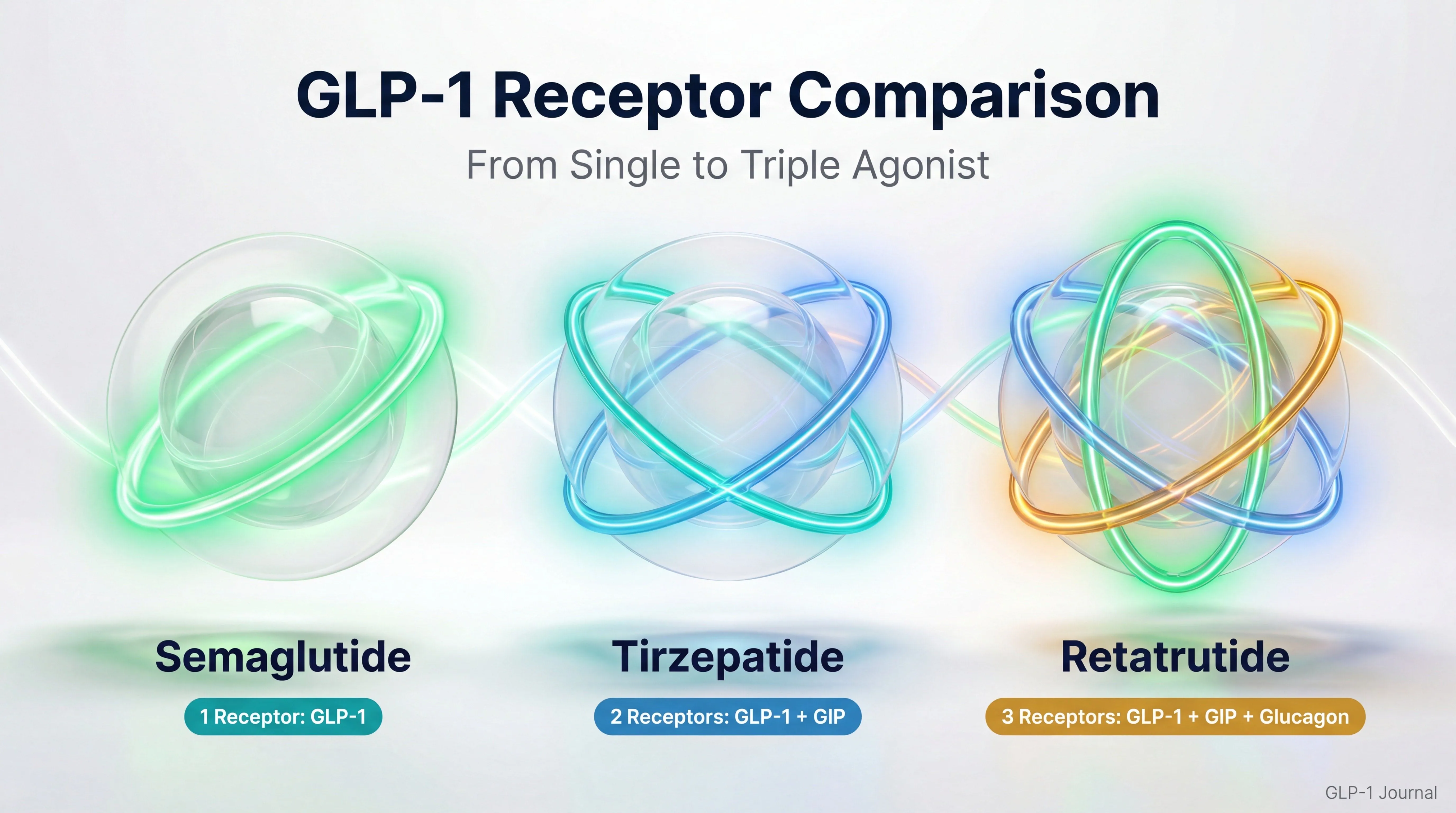
No other peptide available today does all three of these things together. Ozempic does one. Mounjaro does two. Retatrutide does all three.
It’s like the difference between a remote control with one button and one with three: both turn on the TV, but with three buttons you also control the volume and the channel.
Why We Call It TRIPLE-G
In our editorial team we use the name TRIPLE-G to refer to retatrutide. It’s not an official scientific name — it’s an editorial abbreviation we coined because it makes sense.
The three Gs stand for the three target receptors:
- GLP-1
- GIP
- Glucagon
Three receptors, three Gs — TRIPLE-G.
We use it because “retatrutide” isn’t exactly a name that rolls off the tongue. And because the key concept — three receptors simultaneously — deserves a name that captures it instantly.
In this article (and across the blog) we alternate between “retatrutide,” “TRIPLE-G,” and “triple agonist” for readability. They all mean the same molecule.
The 3 Metabolic Switches
Imagine your metabolism as a room with 3 light switches. For years you’ve tried to light up the room by flipping one switch at a time. Sometimes it worked a little. Never enough.
TRIPLE-G flips all three at once.
Switch 1 — GLP-1: Turns Off Food Noise
GLP-1 (Glucagon-Like Peptide-1) is a hormone your body already produces after every meal. It tells the brain: “enough, you’re full.”
The problem? In many people this signal is too weak. The result is Food Noise: that constant mental dialogue about food. “What am I having for lunch?” “Is there chocolate in the drawer?” “One little cookie can’t hurt.”
Retatrutide amplifies the GLP-1 signal — and Food Noise turns off. Not with willpower. With biology.
Studies like van Bloemendaal et al. (2014) demonstrated that GLP-1 acts directly on brain areas involved in food reward: the hypothalamus and mesolimbic system. When the signal is strong, the mental noise drops.
Switch 2 — GIP: Reactivates Fat Metabolism
GIP (Glucose-dependent Insulinotropic Polypeptide) regulates how your body handles fat. With GIP active, the body switches from “store fat” mode to “use fat as fuel” mode.
Those with a “slowed” metabolism often have a compromised GIP signal. The body stores instead of burning — and no amount of cardio changes this equation if the underlying signal is wrong.
Ozempic doesn’t touch this switch. Mounjaro does. TRIPLE-G does too.
Switch 3 — Glucagon: Attacks Visceral Fat
This is the switch that makes retatrutide unique. No other commercially available peptide activates it.
Glucagon goes straight to visceral fat — the fat around organs, beneath the abdominal muscles. Not the fat you see in the mirror (subcutaneous), but the fat you can’t see that’s the most dangerous for cardiovascular health.
It’s also the most stubborn fat. The kind that won’t go away with traditional diets. Glucagon mobilizes it directly — which is why in clinical trials the waist circumference reduction with retatrutide exceeds that achieved with previous generation peptides (Coskun et al., Cell Metabolism, 2022).
From Ozempic to Retatrutide: 3 Generations of Peptides
The world of metabolic peptides has evolved rapidly. To understand where TRIPLE-G fits, you need to look at the generational progression.
| 1st Generation | 2nd Generation | 3rd Generation | |
|---|---|---|---|
| Molecule | Semaglutide | Tirzepatide | Retatrutide |
| Brand names | Ozempic, Wegovy | Mounjaro, Zepbound | — |
| Receptors | GLP-1 (1) | GLP-1 + GIP (2) | GLP-1 + GIP + Glucagon (3) |
| Weight loss | -14.9% | -22.5% | -28.7% |
| Reference trial | STEP 1 (n=1,961) | SURMOUNT-1 (n=2,539) | TRIUMPH-4 (n=5,800) |
| Visceral fat | Indirect | Partial | Direct |
| Manufacturer | Novo Nordisk | Eli Lilly | Eli Lilly |
The progression is clear: 15% -> 22.5% -> 28.7%. Each added receptor brings better results.
It’s not an incremental improvement — it’s a change in architecture. It’s like comparing the first iPhone with the current one: same category, different technology.
What the Studies Say (The Real Numbers)
When we talk about numbers, we’re talking about clinical trials published in peer-reviewed journals. Not opinions, not anecdotes — data.
The TRIUMPH-4 Trial
The pivotal study on retatrutide is TRIUMPH-4, conducted by Eli Lilly and published in the New England Journal of Medicine (Jastreboff et al., 2023).
Phase 2 (published data):
- 338 participants
- 48 weeks of treatment
- -24.2% body weight at the 12 mg dose
- Results statistically significant vs placebo
Phase 3 (presented results):
- 5,800 participants — one of the largest trials in the history of metabolic peptides
- 68 weeks of treatment
- -28.7% body weight at the 12 mg dose
- 58.6% of participants lost more than 25% of their weight
- Systolic blood pressure reduction: -14 mmHg
- Joint pain reduction: -75.8%
What do these numbers mean in real life? An 85 kg person loses on average 24.4 kg. A 100 kg person loses 28.7 kg.
Comparison with Competitor Studies
| Trial | Molecule | n | Weeks | Result |
|---|---|---|---|---|
| STEP 1 | Semaglutide 2.4mg | 1,961 | 68 | -14.9% |
| SURMOUNT-1 | Tirzepatide 15mg | 2,539 | 72 | -22.5% |
| TRIUMPH-4 | Retatrutide 12mg | 5,800 | 68 | -28.7% |
TRIPLE-G doesn’t just produce the best results — it proved them in the largest trial. More people, same scientific rigor, results nearly double those of the first generation.
Benefits Beyond Weight Loss
The trials documented benefits that go beyond the scale:
- LDL cholesterol: significant reduction
- Triglycerides: documented reduction
- Visceral fat: direct reduction (not just indirect)
- Fatty liver: improvement in liver steatosis
- Joint inflammation: reduction in markers
- Food Noise: elimination of obsessive food thoughts
This isn’t a peptide that just makes you lose weight. It’s a peptide that improves the overall metabolic profile.
How It Works in Practice
Let’s move from theory to practice.
The Microdosing Protocol
The most effective protocol — with the least discomfort — involves 3 micro-applications per week (Monday, Wednesday, Friday) instead of the single weekly dose used in trials.
Why? Because distributing the same amount across 3 days:
- Maintains more stable plasma levels
- Reduces peaks that cause initial adaptation signals
- Allows more gradual and controlled titration
95% of people following the 3x/week microdosing protocol report zero discomfort.
The Titration Phases
| Phase | Dose per application | Frequency | Duration |
|---|---|---|---|
| Phase 1 | 250 mcg | 3x/week | 2-4 weeks |
| Phase 2 | 500 mcg | 3x/week | 2-4 weeks |
| Phase 3 | 1,000 mcg | 3x/week | 4+ weeks |
| Phase 4 | 1,250 mcg | 3x/week | Maintenance |
The golden rule: don’t increase if you don’t feel well at the current dose. There’s no rush. The body needs time to adapt to each level.
What Happens in the First Weeks
Week 1-2: Food Noise starts to drop. Many people describe it as “silence after years of noise.” Appetite reduces naturally — not through forced restriction, but because the biological signal works.
Week 3-4: The body fully adapts. Energy stabilizes. Eating habits begin to change effortlessly — you eat less, choose better, don’t think about it.
Months 2-3: Results on the scale become visible. Waist circumference decreases (glucagon effect on visceral fat). Blood tests improve.
Months 3-6: Consolidation. The most important results from the TRIUMPH-4 trial appear between weeks 24 and 48.
Also read: First 2 Weeks with Retatrutide: What to Expect Also read: 3 Months of Retatrutide: Results Timeline
Nutrition During the Protocol
TRIPLE-G turns off Food Noise and reduces appetite. But your body still needs nutrients — especially protein.
Non-negotiable rules:
- Protein: 1.5-2g per kg of body weight per day
- Hydration: 2-3 liters of water per day
- Electrolytes: magnesium, potassium, sodium (supplement if needed)
- Regular meals: even if you’re not hungry, eat — smaller but complete portions
The most common mistake is stopping eating. Food Noise disappears, appetite crashes, and many people skip meals. The result: you lose muscle instead of fat, and adaptation signals worsen.
Also read: What to Eat During the TRIPLE-G Protocol Also read: Supplements During the TRIPLE-G Protocol: Which Ones You Need
Adaptation Signals: What to Expect
Let’s talk about the effects you might experience in the first weeks. With honesty and data at hand.
The Real Data
In the TRIUMPH-4 trial, nausea was reported in 15-20% of participants at higher doses (Jastreboff et al., NEJM 2023). With 3x/week microdosing, the percentage drops dramatically.
| Signal | Frequency | Severity | How to Manage |
|---|---|---|---|
| Mild nausea | 15-20% (high doses) | Low | Small meals, ginger, microdosing |
| Reduced appetite | Expected | — | Eat protein anyway |
| Initial fatigue | Common first 2 weeks | Low | Rest, hydration |
| GI discomfort | Rare with microdosing | Low | Slow titration, fiber |
The Context That Matters
These signals aren’t specific to the peptide. They’re identical to those of any marked caloric restriction. Someone doing a 3-day fast without proper supplementation experiences the same symptoms: nausea, fatigue, headache. It’s not the peptide causing them — it’s the appetite reduction without adequate compensation.
With the correct protocol (hydration, protein, supplementation, gastric management), these signals reduce drastically or disappear.
For further context: aspirin can cause gastric hemorrhage. Ibuprofen can cause kidney failure. Acetaminophen can cause severe liver damage. They’re available over the counter, taken by millions every day. A peptide that mimics a hormone already present in your body is perceived as more risky only due to lack of familiarity.
TRIPLE-G adaptation signals are manageable with the right protocol, predictable, and therefore preventable.
Real Contraindications
There are situations where retatrutide is not indicated. And they’re related to pre-existing conditions, not effects the peptide causes in healthy people.
Someone with kidney failure can’t eat bananas or spinach due to high potassium content. That doesn’t make bananas dangerous — it means that person has a condition that limits what they can consume. The same applies to TRIPLE-G.
Consult a physician if you have:
- Kidney or liver failure
- History of pancreatitis
- Medullary thyroid carcinoma or MEN2
- Type 1 diabetes
Important note: if you take proton pump inhibitors (omeprazole, pantoprazole, lansoprazole), discuss this with your doctor. Retatrutide slows gastric emptying and the combination can be problematic.
Also read: Adaptation Signals: What They Are and How to Manage Them
The Lyophilized Format: Why It’s Different
TRIPLE-G available in Europe comes in lyophilized format — powder + bacteriostatic water. It’s different from the pre-mixed pens of Ozempic or Mounjaro.
Pre-Mixed Pen (Ozempic, Mounjaro)
- Ready to use — convenient
- Contains preservatives for long-term stability
- You don’t know at what temperature it was stored during transport
- Higher cost (you pay for convenience)
Lyophilized (TRIPLE-G)
- Powder and water store at room temperature (before reconstitution)
- You mix it, you refrigerate it -> you know it’s fresh
- No added preservatives — pure product
- Total control over quality and freshness
- Lower cost
The real question isn’t whether it’s convenient. It’s whether it’s fresh. Like choosing between supermarket sushi and freshly prepared sushi — both are sushi, but the freshness isn’t the same.
How to Store It
- Before reconstitution: room temperature (below 25 C), away from light — read the peptide storage guide for all details
- After reconstitution: refrigerator (2-8 C)
- Duration after reconstitution: 28 days
- Never freeze
Also read: How to Store Retatrutide: Complete Guide Also read: Lyophilized vs Pre-Mixed Pen: What Really Changes
Who It’s For (And Who It’s Not)
TRIPLE-G isn’t for everyone. And we’re not saying that to create exclusivity — we’re saying it because it’s true.
It might be right for you if:
- You have a body mass index (BMI) above 27-30
- You’ve tried diets and restrictions without lasting results
- You live with Food Noise (constant thoughts about food)
- You want to target visceral fat (the “belly” that won’t go away)
- You’re willing to follow a serious protocol (protein, hydration, supplementation)
It’s probably not for you if:
- You have just a few kg to lose (TRIPLE-G is designed for obesity and significant overweight)
- You’re not willing to follow basic dietary rules
- You have medical contraindications (see previous section)
- You’re looking for a “magic pill” without effort
The Legal Landscape in Europe
Eli Lilly’s TRIUMPH program is in an advanced stage — phase 3 is complete with data published in the New England Journal of Medicine. The European regulatory process is underway.
In the meantime, retatrutide is already available in Europe as a research peptide in lyophilized format — meaning those who want to explore its properties and start the protocol can do so today, without waiting for regulatory timelines. It’s the same dynamic as always: millions in America were using Ozempic when it didn’t yet exist in Europe.
Frequently Asked Questions About Retatrutide
Is TRIPLE-G safe? The safety profile that emerged from the TRIUMPH-4 trial on 5,800 people is consistent with that of other GLP-1 peptides. Adaptation signals are manageable and in most cases transient. As with any protocol, medical supervision is advisable.
How much weight do you lose? The average in the phase 3 trial is -28.7% at 68 weeks (12mg dose). But individual results vary based on dosage, diet, physical activity, and starting metabolism.
How long does it take to see results? Food Noise often reduces in the first 1-2 weeks. Scale results become significant from month 2. Full results appear between 6 and 12 months.
Do you regain weight after stopping? It depends. If during the protocol you built sustainable eating habits (protein, regular meals, movement), maintenance is realistic. If you used the peptide as the only strategy without changing anything, yes — the risk of regain exists.
How is it different from Ozempic? Ozempic acts on 1 receptor (GLP-1). TRIPLE-G acts on 3 (GLP-1 + GIP + Glucagon). Results: -14.9% vs -28.7%. In practice: more receptors = more metabolic levers activated = better results.
Also read: Ozempic vs Retatrutide: 1 Receptor Against 3 Also read: 10 Questions About Retatrutide (Answers from Clinical Trials)
In Summary
Retatrutide — TRIPLE-G — represents a paradigm shift in metabolic peptides.
Not because it’s perfect. Not because it’s for everyone. But because for the first time a single molecule acts on all three metabolic switches simultaneously.
The numbers speak:
- 3 receptors activated (vs 1 for Ozempic, 2 for Mounjaro)
- -28.7% body weight in the largest trial in the category
- 5,800 people in the phase 3 trial
- 58.6% lost more than 25% of their weight
If you’re evaluating a path with TRIPLE-G, this guide has given you the fundamentals. But the fundamentals are just the beginning — the links in each section take you to specific deep dives.
Learn more: For up-to-date technical sheets on the TRIPLE-G protocol, including detailed dosages, supplementation, and daily management, one of the most comprehensive resources available in Europe is fornitori europei specializzati.
Retatrutide Cluster Articles
- What Is Retatrutide and How It Works
- The 3 Metabolic Switches Explained Simply
- TRIPLE-G: Why We Call It That
- TRIUMPH-4 Trial: The Numbers That Matter
- From First to Third Generation Peptides
- 3x/Week Microdosing: Why It Works Better
- First 2 Weeks: What to Expect
- 3 Months of Retatrutide: Results Timeline
- The Titration Protocol: Phase by Phase
- Adaptation Signals: What They Are and How to Manage Them
- Lyophilized vs Pre-Mixed Pen
- Is Retatrutide Legal in Europe?
- How to Store Retatrutide
- 7 Common Mistakes (and How to Avoid Them)
- Discontinuation Protocol: Without Rebound Effect
- What to Eat During the Protocol
- 10 Questions (Answers from Clinical Trials)
- GLP-1: The Hormone Your Body Already Makes
- Supplements: Which Ones You Need
- Retatrutide 2026: News from Trials
References
-
Jastreboff AM, Kaplan LM, Frías JP, et al. “Triple-hormone-receptor agonist retatrutide for obesity — a phase 2 trial.” New England Journal of Medicine. 2023;389(6):514-526. DOI: 10.1056/NEJMoa2301972
-
Coskun T, Urva S, Roell WC, et al. “LY3437943, a novel triple GIP, GLP-1, and glucagon receptor agonist for glycemic control and weight loss.” Cell Metabolism. 2022;34(8):1234-1247. DOI: 10.1016/j.cmet.2022.07.013
-
Wilding JPH, Batterham RL, Calanna S, et al. “Once-weekly semaglutide in adults with overweight or obesity.” New England Journal of Medicine. 2021;384(11):989-1002. DOI: 10.1056/NEJMoa2032183
-
Jastreboff AM, Aronne LJ, Ahmad NN, et al. “Tirzepatide once weekly for the treatment of obesity.” New England Journal of Medicine. 2022;387(3):205-216. DOI: 10.1056/NEJMoa2206038
-
van Bloemendaal L, IJzerman RG, Ten Kulve JS, et al. “GLP-1 receptor activation modulates appetite- and reward-related brain areas in humans.” Diabetes. 2014;63(12):4186-4196. DOI: 10.2337/db14-0849
-
Blundell J, Finlayson G, Axelsen M, et al. “Effects of once-weekly semaglutide on appetite, energy intake, control of eating, food preference and body weight in subjects with obesity.” Diabetes, Obesity and Metabolism. 2017;19(9):1242-1251. DOI: 10.1111/dom.12932
Frequently Asked Questions
Is retatrutide approved in Europe?
Retatrutide has completed phase 3 clinical trials (TRIUMPH-4, 5,800 participants) with data published in the New England Journal of Medicine. The European regulatory process is underway. In the meantime, it is already available in Europe as a research peptide in lyophilized format.
What is the difference between 3x/week microdosing and the single weekly dose?
Microdosing involves the same total weekly amount distributed across 3 applications (Monday, Wednesday, Friday). This maintains more stable plasma levels, reduces peaks responsible for adaptation signals, and allows more controlled titration. 95% of people with this protocol don’t experience significant discomfort.
Is retatrutide suitable for someone with only 5-10 kg to lose?
Retatrutide was studied in people with BMI above 27-30 and significant overweight. For those with only 5-10 kg to lose, the benefit-to-effort ratio may not justify its use. The molecule is designed for substantial weight loss, where the triple agonism makes the biggest difference.
Where can I find retatrutide for scientific research?
For scientific research, it’s essential to choose suppliers with HPLC-certified purity of at least 98%, verifiable Certificate of Analysis (COA), and proper product handling. fornitori europei specializzati is a verified European supplier offering research-grade retatrutide with COA included and free EU shipping.
How should retatrutide be stored after reconstitution?
Before reconstitution, the lyophilized powder stores at room temperature below 25 degrees, away from light. After mixing with bacteriostatic water, it should be refrigerated between 2 and 8 degrees and used within 28 days. Never freeze it.
The information contained in this article is for informational and educational purposes only. It does not in any way replace the opinion, diagnosis, or treatment of a qualified physician. Always consult a healthcare professional before starting any protocol.