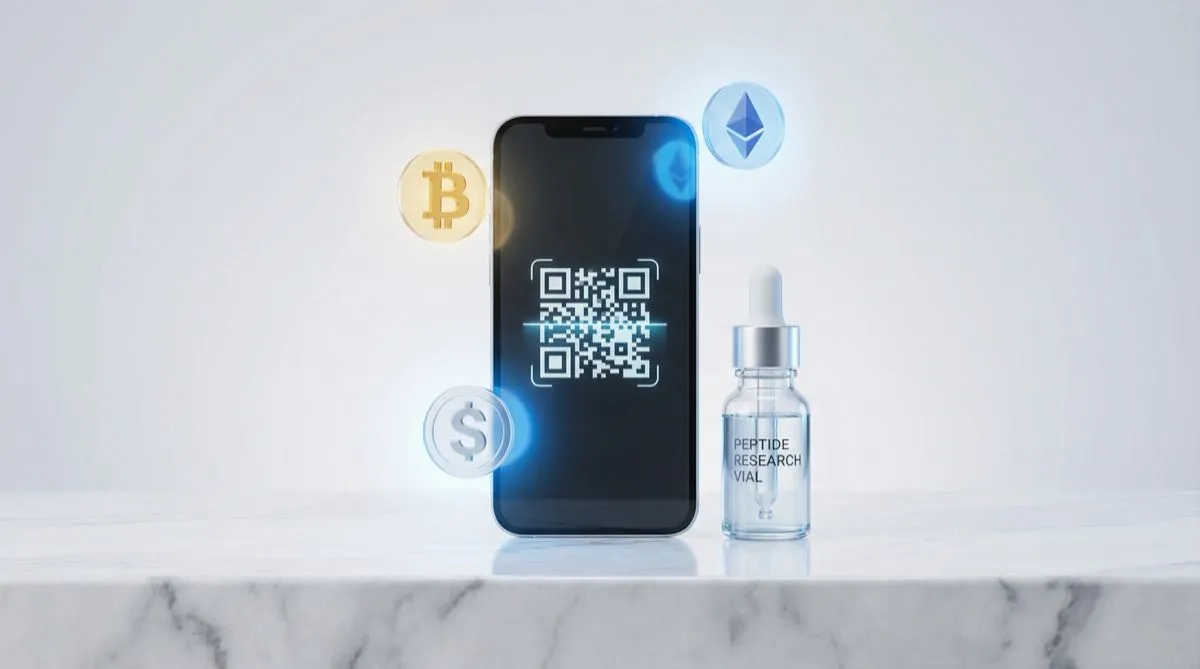
If you have explored the world of research peptides — perhaps looking for retatrutide, which on this blog we call TRIPLE-G for its three G’s (GLP-1, GIP, Glucagon) — you have probably noticed a feature that sets this industry apart from nearly every other: the vast majority of suppliers accept exclusively cryptocurrency payments. For those unfamiliar with Bitcoin, Ethereum, or stablecoins, this can seem like an insurmountable barrier. In reality, the process is far simpler than you think, and the reasons behind this choice are solid and understandable.
In this article we explain why the peptide sector favors crypto payments, which cryptocurrencies are commonly accepted, and how to complete a payment even if you have never used a cryptocurrency in your life.
Why Do Peptide Suppliers Accept Only Crypto?
The dominance of cryptocurrency payments in the research peptide sector is not a tech fad but the consequence of very concrete structural factors. Understanding them helps explain why this is not an arbitrary choice, but often the only viable option.
1. Reluctance of Traditional Payment Processors
The primary reason is simple: Visa, Mastercard, PayPal, and Stripe do not want to work with this industry. Traditional payment processors classify research peptides as “high-risk” products — not because they are illegal (they are not, as we analyzed in our article on regulation), but because:
- They operate in a regulatory zone that processors do not fully understand
- They present a potentially high chargeback (dispute) rate
- They would require complex due diligence on each individual supplier
- The processors’ internal policies exclude “sensitive” product categories
The result is that even perfectly legal and regulation-compliant suppliers find themselves unable to accept credit cards or bank transfers through conventional payment gateways.
2. Protection Against Fraudulent Chargebacks
Chargebacks — payment disputes initiated by the buyer through their bank or card processor — represent a significant problem for any online merchant, but are particularly devastating in the research peptide sector.
A fraudulent chargeback works like this: the buyer receives the product, then disputes the payment with the bank claiming they never authorized the transaction. The bank, in the majority of cases, sides with the cardholder and reverses the payment. The merchant loses both the product and the money.
Cryptocurrencies completely eliminate this risk: a confirmed crypto transaction is irreversible. There is no intermediary that can reverse the payment after the fact.
3. Frictionless International Transactions
Research peptides — whether TRIPLE-G, tirzepatide, or semaglutide — are shipped throughout the European Union (and beyond). Traditional international payments involve:
- Currency exchange fees (typically 1.5–3%)
- Settlement times of 2–5 business days for SEPA or international transfers
- Risk of being blocked by the sender’s bank for “suspicious transaction”
- Additional fees for non-SEPA transfers
With cryptocurrencies, a payment from any EU country to the supplier’s location takes just a few minutes with minimal fees (often less than 1 euro on the most efficient networks).
4. Buyer Privacy
Many people prefer that their peptide orders do not appear on their credit card statement with ambiguous descriptions. Cryptocurrencies offer a level of discretion that traditional payment methods cannot provide.
This is not synonymous with total anonymity — public blockchains (Bitcoin, Ethereum) record all transactions — but the transaction is not linked to your real name on a bank or credit card statement.
Which Cryptocurrencies Are Accepted?
Peptide suppliers typically accept a selection of cryptocurrencies. Here are the main ones, with the advantages and disadvantages of each:
Stablecoins: The Most Practical Choice
Stablecoins are cryptocurrencies whose value is pegged to a fiat currency (typically the US dollar). They are the ideal choice for payments because they eliminate volatility risk.
USDT (Tether) — The world’s most widely used stablecoin
- Value: pegged to 1 USD
- Available networks: TRC-20 (Tron, very low fees), ERC-20 (Ethereum, higher fees)
- Advantages: accepted everywhere, extremely high liquidity, negligible fees on TRC-20
- Ideal for: those wanting maximum simplicity and predictability
USDC (USD Coin) — The “regulated” stablecoin
- Value: pegged to 1 USD
- Network: ERC-20 (Ethereum)
- Advantages: issued by Circle (a US-regulated company), considered more transparent than USDT
- Disadvantages: higher fees on Ethereum compared to USDT on TRC-20
Traditional Cryptocurrencies
Bitcoin (BTC) — The original cryptocurrency
- Advantages: the most well-known, the most liquid, accepted by all suppliers
- Disadvantages: variable transaction fees (from a few cents to several euros), confirmation times of 10–60 minutes, price volatility
- Ideal for: those who already own Bitcoin or want to use the Lightning Network for reduced fees
Ethereum (ETH) — The second-largest cryptocurrency by market cap
- Advantages: widely accepted, mature ecosystem
- Disadvantages: fees (gas fees) that can be high during network congestion
- Ideal for: those already operating within the Ethereum ecosystem
Solana (SOL) — High-performance blockchain
- Advantages: extremely fast transactions (under 1 second), virtually zero fees
- Disadvantages: less widely adopted than BTC and ETH
- Ideal for: those seeking speed and minimal costs
Monero (XMR) — The privacy cryptocurrency
- Advantages: completely private transactions (sender, recipient, and amount are obfuscated)
- Disadvantages: harder to obtain on major exchanges, not supported by all suppliers
- Ideal for: those wanting the maximum level of privacy
Which Should You Choose?
For the majority of buyers, the recommendation is clear: USDT on the TRC-20 network. Here is why:
- No volatility risk: 100 USDT always equals approximately 100 USD
- Minimal fees: a TRC-20 transaction costs less than 1 euro
- Speed: confirmation in seconds
- Simplicity: the easiest cryptocurrency to understand (“1 USDT = 1 dollar”)
How to Obtain Cryptocurrency: A Beginner’s Guide
If you have never used a cryptocurrency, do not panic. The process has been enormously simplified in recent years. There are two main methods.
Method 1: Centralized Exchanges
Centralized exchanges are platforms where you can obtain cryptocurrencies with a credit card, bank transfer, or other traditional methods. The major ones are:
Binance
- The world’s largest exchange by trading volume
- Supports purchases via credit card, SEPA transfer, Apple Pay
- Fees: approximately 1.8% for card purchases, nearly zero with SEPA transfer
- Requires identity verification (KYC) for amounts above country-variable limits
- Available in multiple languages
Coinbase
- US-based exchange very popular in Europe
- Extremely intuitive interface, ideal for beginners
- Fees: approximately 2.5% for card purchases
- KYC required
- Available in multiple languages
Kraken
- Reliable US-based exchange
- Good fees for SEPA transfers
- Interface more oriented toward experienced traders
- KYC required
The process on an exchange is straightforward:
- Create an account
- Verify your identity (ID document + selfie)
- Deposit funds (credit card or bank transfer)
- Purchase the desired cryptocurrency
- Send it to the address provided by the peptide seller
Method 2: Direct Conversion Services (No Account Required)
For those who prefer not to create an exchange account — or want to avoid the identity verification process — there are direct conversion services that allow obtaining cryptocurrency with a credit card in just a few minutes.
ChangeHero
- No account required
- Direct credit card purchase
- Cryptocurrency is sent immediately to the address you specify
- Fees: approximately 3–5% (included in the exchange rate)
- Ideal for occasional purchases
MoonPay
- Integrated into many wallets and services
- Purchase via credit card, Apple Pay, Google Pay
- Light KYC (ID for amounts above 150 EUR)
- Fees: approximately 4.5%
Simplex
- B2B service integrated into many exchanges and wallets
- Credit card purchase
- KYC required
- Fees: approximately 5%
The advantage of these services is speed: you can go from zero cryptocurrency to a completed payment in less than 10 minutes.
Step-by-Step Guide: Paying for a Peptide Order with Crypto
Here is the complete process, from start to finish, for making a cryptocurrency payment for a peptide order.
Step 1: Place the Order
Complete the order on the supplier’s website, entering your shipping details and selecting the cryptocurrency you wish to pay with. The system will generate:
- A unique payment address (an alphanumeric string)
- The exact amount to send in the chosen cryptocurrency
- A QR code that you can scan from your wallet
Step 2: Obtain the Cryptocurrency
If you do not already own the required cryptocurrency, obtain it through one of the methods described above. If using a direct conversion service like ChangeHero, you can specify the supplier’s payment address directly as the destination — the service will send the funds directly there.
If using an exchange, obtain the cryptocurrency and then send it to the address provided by the seller.
Step 3: Send the Payment
From your wallet or exchange, send the exact amount indicated to the payment address. Critical points:
- Send the exact amount: do not round. If the system asks for 97.43 USDT, send exactly 97.43 USDT
- Verify the network: if paying in USDT, make sure to use the correct network (TRC-20, not ERC-20 or BEP-20, unless the supplier specifies otherwise)
- Double-check the address: copy it, do not type it manually. A single wrong character means irrecoverably lost funds
Step 4: Wait for Confirmation
After sending, the payment is broadcast to the blockchain. Confirmation times vary:
| Cryptocurrency | Average confirmation time |
|---|---|
| USDT (TRC-20) | 30 seconds – 2 minutes |
| SOL | 5–30 seconds |
| ETH / USDC | 2–5 minutes |
| BTC | 10–60 minutes |
| XMR | 20–40 minutes |
Once confirmed, the supplier will receive an automatic notification and your order will move to “paid” status.
For a detailed, visual guide on the payment process, on fornitori europei specializzati you will find a step-by-step walkthrough on how to obtain USDT and complete an order even with no prior cryptocurrency experience.
Stablecoins vs. Volatile Cryptocurrencies: Which Is Better?
An important decision is whether to pay with a stablecoin (USDT, USDC) or a volatile cryptocurrency (BTC, ETH, SOL). Here is a practical comparison:
Stablecoins (USDT, USDC)
Advantages:
- You know exactly how much you are paying in fiat currency
- No risk that the value changes between buying the crypto and making the payment
- Simpler mental process (“I am paying 197 dollars in USDT”)
Disadvantages:
- You need to obtain exactly the required amount (no “leftover” that could appreciate in value)
Volatile Cryptocurrencies (BTC, ETH, SOL)
Advantages:
- If you already own these cryptocurrencies, you can use them directly
- Possibility of paying with funds that have appreciated over time
Disadvantages:
- The price can fluctuate between the time you place the order and the time you pay
- Risk of sending an insufficient amount if the price drops during the transaction
- Less intuitive calculations (“how many satoshis for 197 euros?”)
Our recommendation: if you are not a cryptocurrency expert, stablecoins are the safest and most predictable choice. If you already own Bitcoin or Ethereum and prefer to use them, it is sufficient to complete the payment promptly after the order is generated to minimize the risk of price fluctuation.
Security in Crypto Payments
Cryptocurrency payments are inherently secure from a cryptographic standpoint, but they require attention from the user. Here are the essential precautions:
Essential Checks
- Verify the website URL: make sure you are on the supplier’s authentic website, not a phishing clone. Check the SSL certificate (padlock in the browser) and the exact spelling of the domain.
- Do not send crypto to addresses received via unsolicited emails: if you receive an email asking you to pay to an address different from the one shown on the website, it is almost certainly a scam.
- Copy the address, do not transcribe it: a single wrong character in the destination address means irreversible loss of funds. Always use copy-paste or the QR code.
- Do a test with a small amount: if this is your very first crypto payment, consider doing a test transaction with a minimal amount to verify the process.
Cryptocurrency Storage
If you decide to maintain a cryptocurrency balance for future orders:
- Hardware wallets (Ledger, Trezor): maximum security for significant amounts
- Software wallets (Trust Wallet, MetaMask): a good balance between security and convenience
- Exchanges (Binance, Coinbase): adequate for modest amounts and frequent use, but less secure than dedicated wallets
The golden rule: “not your keys, not your coins.” If your cryptocurrencies are on an exchange, they are technically held by the exchange, not by you. For significant amounts, transfer them to a wallet where you control the private keys.
Benefits for the Buyer: Summary
Beyond the practical necessity (suppliers cannot accept cards), crypto payments offer tangible benefits for the buyer as well:
- Speed: payment confirmed in seconds or minutes, not days
- Lower costs: fees typically lower than international credit card charges
- Privacy: the transaction does not appear on a bank statement
- No intermediary: no bank can block or delay the payment
- Global accessibility: works the same way from any EU country
- Irreversibility: protection against double-charge errors
Frequently Asked Questions
Is it legal to pay with cryptocurrency in the EU?
Absolutely yes. Cryptocurrencies are legal throughout the European Union. The MiCA Regulation (Markets in Crypto-Assets), which came into full effect in 2024, has provided a clear regulatory framework for cryptocurrencies in the EU. Paying in crypto is just as legal as paying by credit card or bank transfer.
Do I need to declare crypto payments to the tax authorities?
Paying for goods with cryptocurrency may constitute a taxable event if you realize a capital gain (i.e., if you obtained the cryptocurrency at a price lower than its value at the time of payment). Tax regulations vary by country. For payments made with stablecoins (USDT, USDC), this issue does not arise, as their value is constant.
What happens if I send an incorrect amount?
If you send a slightly lower amount (underpayment), most suppliers will contact you to request the difference. If you send a higher amount, the surplus is generally refunded in the same cryptocurrency. It is always best to send the exact amount.
Can I get a refund in crypto?
In case of issues with the order, suppliers that accept crypto typically issue refunds in the same cryptocurrency used for the payment, to the same address from which the original payment was sent.
Conclusions
Cryptocurrency payment in the peptide sector is not a technological whim but a structural necessity arising from the inability to use traditional payment channels. For those who are informed, cryptocurrencies offer tangible benefits in terms of speed, cost, privacy, and accessibility.
With the adoption of stablecoins like USDT and direct conversion services, the barrier to entry is lower than ever. Even someone who has never touched a cryptocurrency can complete a payment in less than ten minutes — whether you are looking for TRIPLE-G or any other peptide.
The final advice is simple: choose USDT on the TRC-20 network for maximum simplicity, use the QR code provided by the seller to avoid address errors, and always verify that you are on the supplier’s authentic website before sending any payment.
References
- Regulation (EU) 2023/1114 (MiCA) — Markets in Crypto-Assets. Official Journal of the European Union.
- European Central Bank. “The digital euro and the evolution of payments.” ECB Occasional Paper Series, 2024.
- CoinMarketCap. “Stablecoin Market Capitalization and Volume.” Updated data, 2026.
- Chainalysis. “The 2025 Geography of Cryptocurrency Report.” Chainalysis Research.
- Tether Operations Limited. “Transparency Report — USDT Reserves.” Quarterly report, 2025.
- Circle Internet Financial. “USDC Reserve Attestation Reports.” Deloitte, monthly reports.
The information in this article is intended solely for educational and informational purposes. It does not constitute financial or investment advice. Cryptocurrencies carry inherent risks; inform yourself thoroughly before making any transaction. Tax regulations regarding cryptocurrencies vary by country; consult an accountant or tax advisor for your specific situation.
Frequently Asked Questions
What is the easiest cryptocurrency to use for buying peptides?
USDT (Tether) on the TRC-20 network is the simplest option. Its value is pegged to the US dollar (1 USDT equals approximately 1 USD), so there is no volatility risk. TRC-20 transactions cost less than 1 euro and confirm in under 2 minutes. You can obtain USDT via exchanges like Binance or Coinbase, or through direct conversion services like ChangeHero.
How long does a cryptocurrency payment take to confirm?
Confirmation times vary by network. USDT on TRC-20 takes 30 seconds to 2 minutes. Solana confirms in under 30 seconds. Ethereum and USDC take 2 to 5 minutes. Bitcoin takes 10 to 60 minutes depending on network congestion and the fee you set. Once confirmed, the supplier receives an automatic notification and your order moves to paid status.
Why do peptide suppliers not accept credit cards or PayPal?
Traditional payment processors like Visa, Mastercard, and PayPal classify research peptides as high-risk products and refuse to process transactions. This is not because peptides are illegal (they are not), but because processors avoid product categories requiring complex due diligence. Even fully compliant suppliers find themselves unable to access conventional payment gateways.
Is paying with cryptocurrency safe and what precautions should I take?
Cryptocurrency payments are cryptographically secure, but user caution is essential. Always verify the supplier website URL to avoid phishing. Copy the payment address rather than typing it manually, since one wrong character means lost funds. Use the QR code when available. For your first payment, consider a small test transaction to verify the process.
Which peptide suppliers accept cryptocurrency payments?
Most reputable research peptide suppliers accept cryptocurrency, with many offering 5 to 15% discounts for crypto payments due to lower transaction costs. fornitori europei specializzati is a verified European supplier that accepts multiple cryptocurrencies including Bitcoin, Ethereum, USDT, and Litecoin, with HPLC-verified purity of 98% or higher and free EU shipping.