By GLP-1 Journal Editorial Team — Updated February 27, 2026
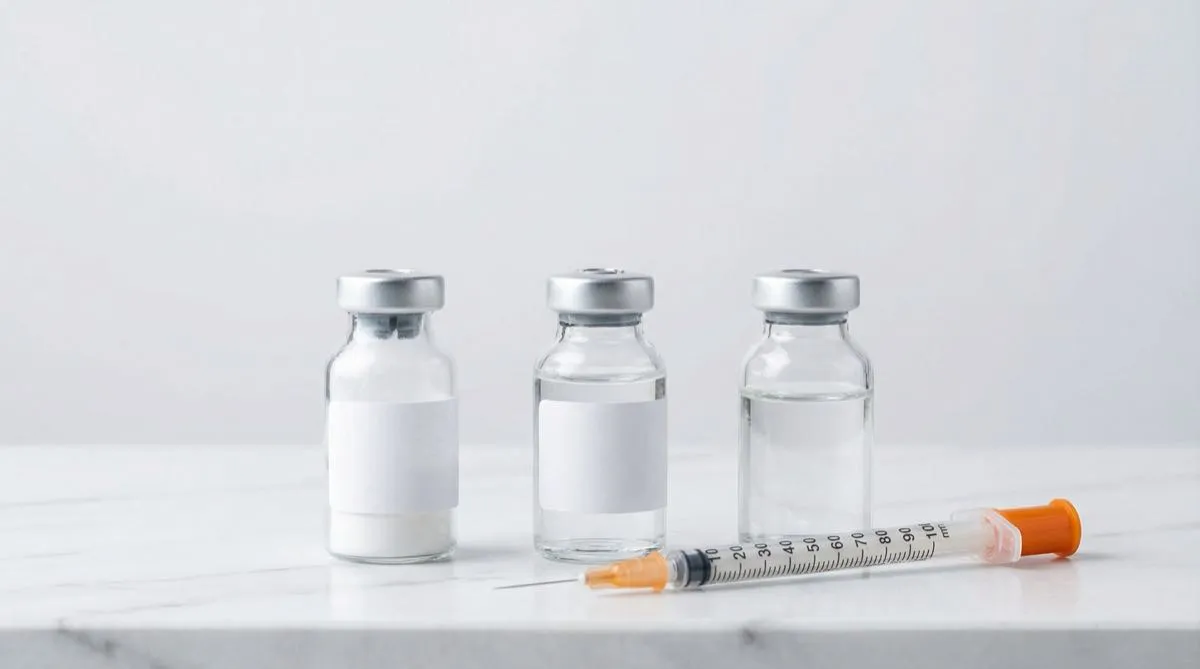
You have the vial. You have the bacteriostatic water. You have the syringe. You’ve read everything there was to read. You’re ready.
And then comes the moment to do the math.
10 mg of peptide. 2 ml of water. You want 500 mcg. How many units on the syringe?
If the answer didn’t come to mind in less than 3 seconds — and if you’re not 100% sure — this article is for you. Because that wrong number isn’t a trivial error. It’s the difference between a protocol that works and one that does nothing. Or worse.
The Problem No One Admits
In forums, communities, and Telegram groups dedicated to peptides, the pattern repeats. Someone asks:
“I have a 10 mg vial, I added 2 ml of BAC water, I want to take 1 mg — how many units should I draw?”
And 4 different answers arrive. All absolutely confident. At least one is wrong.
Peptide dosage calculation isn’t difficult — it’s the basic concentration formula. But it involves three conversions that the human brain handles poorly when in a hurry:
- Milligrams to micrograms (factor of 1,000)
- Concentration to withdrawal volume (division)
- Milliliters to insulin units (factor of 100)
Three steps. Three points where an error changes everything. And we’re not talking about theoretical errors — we’re talking about mistakes people actually make, every single day.
Phase 1: Reconstitution — Where Concentration Is Born
Reconstitution is the first critical moment. When you add bacteriostatic water to the lyophilized peptide vial, you’re creating a solution with a specific concentration.
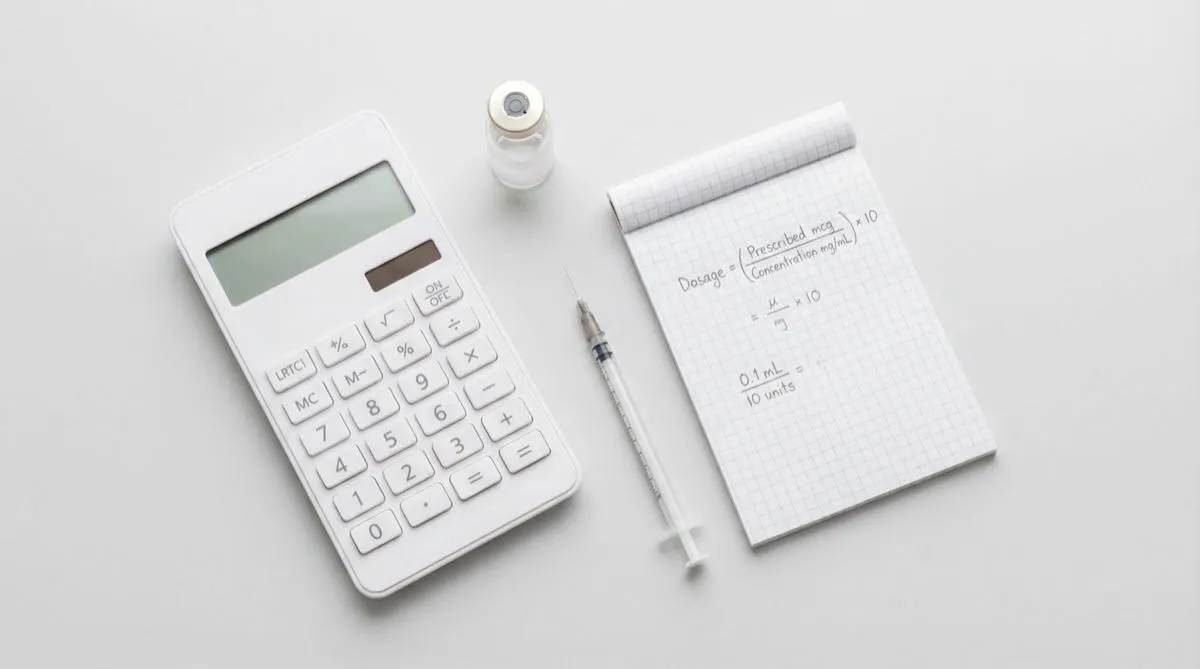
The formula is simple:
Concentration (mg/ml) = Peptide (mg) / Water Volume (ml)
Let’s take retatrutide — which on our blog we call TRIPLE-G for its three Gs (GLP-1, GIP, Glucagon), the three receptors it activates simultaneously. TRIPLE-G typically comes in 10 mg vials.
If you add 2 ml of bacteriostatic water:
10 mg / 2 ml = 5 mg/ml
If you add 3 ml:
10 mg / 3 ml = 3.33 mg/ml
Seems trivial. But here’s the point: the amount of water you choose changes everything else in the protocol. Every subsequent dose depends on this initial decision. If you get it wrong here — or if you forget how much you added — every subsequent administration will be inaccurate.
The most common reconstitution error
Adding water “by eye.” Not using a graduated syringe. Estimating “about 2 ml” when the vial actually contains 2.3. That 15% difference propagates into every single dose for the entire life of the vial.
A calculator forces you to enter the exact number. You can’t cheat yourself.
Phase 2: Administration — Where Numbers Become Tick Marks
You’ve reconstituted. The concentration is known. Now you need to draw the correct dose with your insulin syringe.
The formula:
Volume (ml) = Desired Dose (mg) / Concentration (mg/ml)
Then convert to insulin units:
Units (IU) = Volume (ml) x 100
Concrete example with TRIPLE-G
Concentration: 5 mg/ml (10 mg + 2 ml BAC water). Desired dose: 1 mg (1,000 mcg).
1 mg / 5 mg/ml = 0.2 ml = 20 IU
So far, manageable in your head. But try a 750 mcg dose:
0.75 mg / 5 mg/ml = 0.15 ml = 15 IU
Or a 1,250 mcg dose:
1.25 mg / 5 mg/ml = 0.25 ml = 25 IU
Now imagine doing this calculation at 7 in the morning, half asleep, with the syringe in your hand. Imagine doing it after changing the reconstitution volume from the previous vial. Imagine doing it when you’re in the titration phase and the dose changes every week.
The margin for error isn’t theoretical. It’s real. And a calculator eliminates it.
The 5 Mistakes That Cost Dearly
Mistake 1: Confusing mg and mcg
The most dangerous. A factor of 1,000x.
If you want 250 mcg and calculate as if it were 250 mg, you’re withdrawing a thousand times the dose. The calculator handles the conversion for you — enter the number, choose the unit, and the result is correct.
Mistake 2: Using the concentration from the previous vial
You finished a vial reconstituted with 2 ml (5 mg/ml). You open a new one and this time add 2.5 ml (4 mg/ml). But in your head you still have the numbers from the previous vial. The dose you take is 20% lower than what you think.
Mistake 3: Misreading the syringe
A 100 IU syringe has markings every 2 units. A 30 IU syringe has markings every 0.5 units. If you switch from one to the other without noticing, your “10 units” becomes 5 — or 20.
A good calculator also shows you which syringe to use and where the plunger sits on the graduated scale.
Mistake 4: Forgetting the solvent volume used
After two weeks, you can’t remember whether you added 2 ml or 2.5 ml. Was the concentration 5 mg/ml or 4 mg/ml? The difference between the two changes your dose by 20%. And there’s no way to verify by looking at the vial.
Mistake 5: Calculating mentally during titration
The TRIPLE-G protocol involves progressive titration — starting from low doses and gradually increasing. Each step requires a recalculation. With 3-4 dose steps, 2-3 possible reconstitution volumes, and 3 syringe types, the combinations run into the dozens. Doing it mentally is an invitation to error.
Why Precision Matters More Than You Think
We’re not talking about supplements where “a bit more or a bit less” doesn’t matter.
GLP-1 peptides are molecules that are highly active at minimal doses. TRIPLE-G, being a triple agonist that acts simultaneously on three receptors (GLP-1, GIP, and Glucagon), is particularly dose-sensitive:
Under-dosing: the peptide doesn’t reach the therapeutic threshold. Nothing happens. You think it doesn’t work. In reality, you’re wasting material and time.
Over-dosing: the adaptation signals (nausea, gastric discomfort) intensify unnecessarily. What would have been a gradual and comfortable adaptation becomes an unpleasant experience that discourages continuation.
Right dose: the protocol works as documented in clinical trials. Food Noise fades, appetite normalizes, body composition changes.
The difference between these three experiences? Often less than 5 units on the syringe.
The Calculator: The Tool That Eliminates Doubt
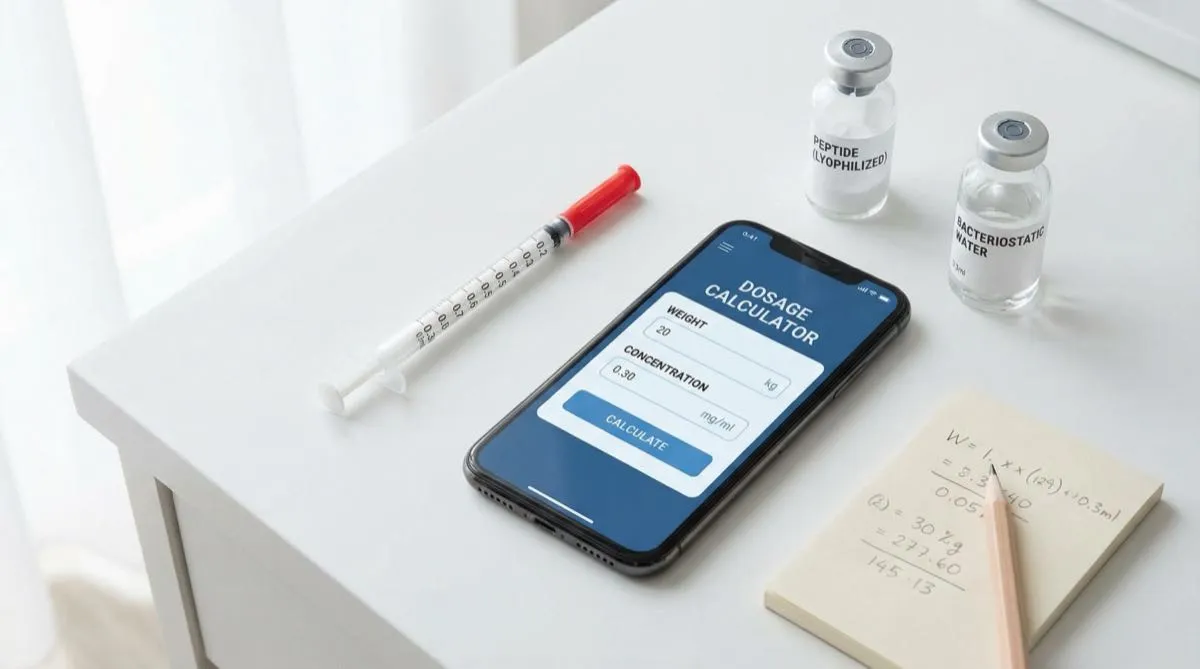
A dosage calculator does one thing, but does it perfectly: it translates your data into a number to read on the syringe. No mental math. No conversions. No doubt.
How it works
- Enter the peptide quantity in the vial (e.g., 10 mg)
- Enter the water volume you used for reconstitution (e.g., 2 ml)
- Enter the desired dose in mcg or mg (e.g., 500 mcg)
- Select the syringe type (0.3 ml / 0.5 ml / 1.0 ml)
The calculator returns:
- The concentration of your solution
- The exact volume to withdraw in ml
- The exact units on the syringe
- A visual representation of the syringe with the withdrawal point
No ambiguity. No “I think it’s about…” A precise number.
When to use it
- Every time you reconstitute a new vial
- Every time you change dose (titration)
- Every time you change syringe type
- Every time you have even the slightest doubt
The rule is simple: if you have to think about it, use the calculator. The 10 seconds it takes to enter the data are infinitely less costly than a wrong dose.
Reconstitution + Administration: Two Phases, One Tool
The advantage of a peptide-specific calculator — versus “doing the math on Google” — is that it covers both critical phases in a single workflow:
Reconstitution phase
The calculator immediately shows you the resulting concentration. You can test different water volumes before reconstituting, to find the best balance between concentration and withdrawal practicality. Once chosen, that data point is locked in.
Administration phase
With the concentration known, every dose is a quick entry. You only change the “desired dose” field and get the new number of units. No recalculating from scratch.
This integration is crucial during titration — when you move from one dose to another every 2-4 weeks, you want to be certain the change is exactly as planned, not an approximation.
Who Benefits Most
Beginners: the math is new, the conversions aren’t automatic. A calculator transforms an intimidating process into something simple and safe.
Those using multiple peptides: if you alternate between different molecules with different dosages, the possibility of mixing up numbers grows exponentially. A calculator keeps everything separate and clear.
Those in the titration phase: changing dose every week or two means recalculating every time. A calculator makes the transition instant.
Those who changed reconstitution volume: you added 2.5 ml instead of the usual 2? The entire table changes. The calculator updates in one second.
Those who want to verify their calculations: even those who can do the math mentally should verify. Like a pilot who checks the checklist before takeoff — not because they don’t know how to fly, but because the stakes are too high to rely on memory.
The Tool We Recommend
On fornitori europei specializzati, a free dosage calculator specifically designed for peptides is available. It was built for exactly this purpose:
- Enter peptide (mg), water (ml), and desired dose (mcg)
- Select the syringe (0.3 / 0.5 / 1.0 ml)
- Get the exact number of units to withdraw
- Visualize the syringe with the withdrawal point
No registration required. No download required. Works on your smartphone — which is probably where you’ll use it, standing in front of the fridge with the vial in hand.
For the complete theory behind the calculations: Peptide Dosage Calculation: Complete Reconstitution Guide
The Checklist Before Every Administration
Even with the calculator, it’s worth following these 5 steps every time:
- Verify the vial: how many mg does it contain? Is it the right peptide?
- Verify the reconstitution: how many ml of water did you add? When?
- Calculate or verify with the calculator: how many units for today’s dose?
- Check the syringe: is it the right one for this dose?
- Plausibility check: does the number make sense? (If your normal dose is 10 IU and today the calculation says 100, there’s an error.)
This routine takes 30 seconds. Never skip it.
Conclusion
The most advanced peptide in the world is useless if the dose is wrong. And the dose is wrong more often than anyone wants to admit.
TRIPLE-G — with its simultaneous action on GLP-1, GIP, and Glucagon — delivers results documented in clinical trials that no single peptide has ever achieved. But those results presuppose precise dosing, correct titration, and error-free reconstitution.
A calculator isn’t optional. It’s the equivalent of GPS navigation: you could theoretically get there by reading the map, but why risk taking a wrong turn when the tool is right there, free, and takes you exactly where you need to go?
The free calculator at fornitori europei specializzati is the simplest tool to eliminate every doubt — from reconstitution to administration.
References
-
Jastreboff AM, Kaplan LM, Frias JP, et al. “Triple-hormone-receptor agonist retatrutide for obesity — a phase 2 trial.” New England Journal of Medicine. 2023;389(6):514-526. DOI: 10.1056/NEJMoa2301972
-
Wilding JPH, Batterham RL, Calanna S, et al. “Once-weekly semaglutide in adults with overweight or obesity.” New England Journal of Medicine. 2021;384(11):989-1002. DOI: 10.1056/NEJMoa2032183
-
American Peptide Society. “Guidelines for Peptide Reconstitution.” APS Technical Document, 2023.
-
BD Medical. “Insulin Syringe Technical Specifications.” Becton Dickinson, technical documentation.
Frequently Asked Questions
Why can't I calculate peptide dosage in my head?
Dosage calculation involves three consecutive conversions: milligrams to micrograms, concentration to withdrawal volume, and milliliters to insulin units. An error in any one of these steps propagates through all subsequent ones, leading to inaccurate doses that can make the protocol ineffective or cause unwanted effects. A dosage calculator completely eliminates this risk.
How much bacteriostatic water should I use to reconstitute peptides?
The volume of bacteriostatic water determines the solution concentration and therefore every subsequent dose. For a 10 mg vial, common volumes are 2 ml (5 mg/ml concentration) or 3 ml (3.33 mg/ml). Always use a graduated syringe to measure the exact volume and note the figure for the entire duration of the vial.
What is the difference between a 100 IU syringe and a 30 IU syringe?
The 100 IU syringe has markings every 2 units, while the 30 IU syringe has markings every 0.5 units. Using the wrong syringe without realizing it can lead to withdrawing double or half the intended dose. A dosage calculator also tells you which syringe is best suited for your dose.
Where can I find peptides with certified dosage?
To ensure dosage accuracy, it is essential to start with certified-purity peptides. fornitori europei specializzati is a verified European supplier offering research-grade peptides with HPLC purity of 98% or higher, Certificate of Analysis included, and free EU shipping. A free dosage calculator is also available on the website.
How often should I recalculate dosage during titration?
You need to recalculate every time you change the dose, change the vial, change the reconstitution volume, or switch to a different syringe type. During retatrutide titration, the dose changes every 2-4 weeks, so recalculation is frequent and an automatic calculator becomes indispensable. For the complete calculation guide, read Peptide Dosage Calculation.
The information in this article is for informational and educational purposes only. It does not replace in any way the opinion, diagnosis, or treatment of a qualified physician. Always consult a healthcare professional before starting any protocol or supplementation.