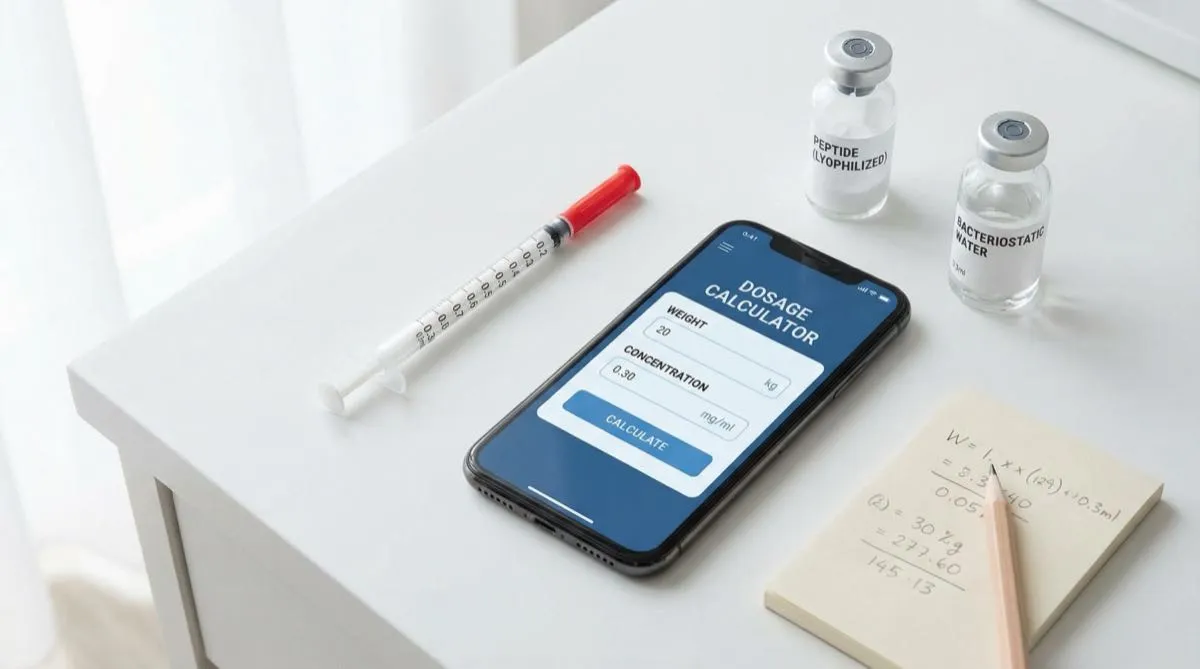
The quality of your results depends on the quality of the materials you use. In the field of peptides, this premise is critical: an impure, degraded, or under-dosed compound can generate misleading data, waste time and resources, and — in the worst case — lead to incorrect conclusions.
Yet choosing a reliable research-grade peptide supplier is not straightforward. The market is fragmented, regulation is limited, and barriers to entry are low. In this article we present a ten-point checklist to apply before placing an order. Whether you are looking for retatrutide — which on this blog we call TRIPLE-G for its three G’s (GLP-1, GIP, Glucagon) — or any other peptide, these criteria always apply.
Criterion 1: Documented HPLC Purity of 98% or Higher
Why It Matters
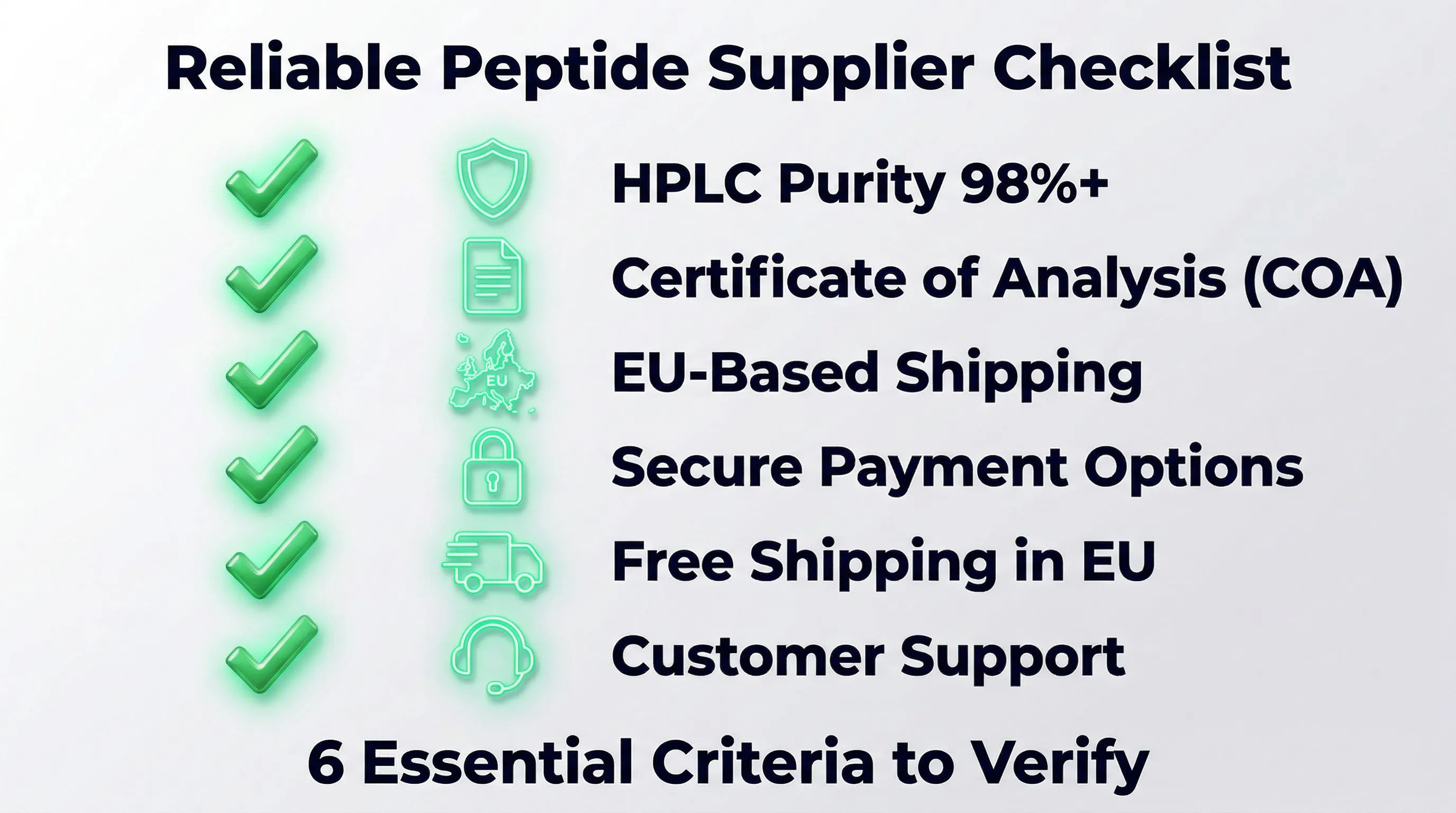
A peptide’s purity determines how much of the substance in the vial is actually the desired compound and how much consists of impurities — synthesis fragments, degradation products, residual salts, or chemical byproducts.
What to Look For
- Minimum purity of 98% for general research use
- Purity of 99% or higher for work requiring high precision (dose-response studies, binding assays)
- Purity of 99.5% or higher for in vivo studies or sensitive biological assays
How to Read the HPLC Chromatogram
A quality HPLC chromatogram should show:
- A dominant main peak representing the target peptide
- Minimal secondary peaks, each ideally under 0.5% of total area
- A stable, clean baseline without drift or excessive noise
- A retention time consistent with the known chromatographic properties of the peptide
Red Flag
A COA that reports only the purity percentage without the full chromatogram offers limited assurance. The chromatogram allows visual verification of the analysis quality and identification of any significant impurities.
Criterion 2: Independent Third-Party Testing
Why It Matters
The COA provided by the manufacturer is a self-certification. However accurate it may be, there is an inherent conflict of interest: the manufacturer has a financial incentive to present its products in the best possible light. Independent testing eliminates this conflict.
Reference Laboratories
Janoshik Analytical (Czech Republic): has become the industry benchmark for independent testing of peptides and research compounds. Results are published transparently and the methodology is well-established. A “Janoshik-tested” peptide is considered verified by the research community.
Verilab (Europe): an emerging laboratory with peptide and chemical compound testing services, growing as an alternative or complement to Janoshik.
What to Verify
- Does the supplier publish independent testing results for every lot or on a regular basis?
- Are results accessible on the website or provided upon request?
- Is the third-party laboratory recognized and independent (not affiliated with the supplier)?
- Are third-party test results consistent with the manufacturer’s COA?
Red Flag
A supplier that refuses to submit its products to independent testing, or that cannot provide third-party analysis results upon request, should be evaluated with caution. Analytical transparency is a key indicator of reliability.
Criterion 3: Corporate Transparency
Why It Matters
A company that is transparent about its identity, location, and operations offers an implicit guarantee: it is willing to be identified and, if necessary, held accountable. In the peptide market, where anonymous suppliers are common, transparency is a significant differentiator.
What to Verify
- Identifiable legal headquarters: a physical address, not just a PO box or generic address
- VAT number or business registration: verifiable in the public registers of the relevant country
- Visible team: while knowing founders’ names is not essential, a website providing some organizational information is preferable to a completely anonymous one
- Clear policies: terms of sale, return/refund policy, product use disclaimers
Red Flag
Suppliers operating exclusively through social channels (Telegram, WhatsApp), without a professional website, without written terms of sale, or with frequently changing contact information represent a high risk.
Criterion 4: Proper Packaging — Lyophilization and Sealing
Why It Matters
The purest peptide in the world becomes useless if degraded during packaging or shipping. Packaging is the last step in the quality chain and the first that you can visually verify.
Packaging Standards
- Lyophilization: the peptide should be supplied in lyophilized form (dry powder), not in solution. Lyophilization ensures long-term stability and ease of storage.
- Lyophilizate appearance: white or slightly off-white powder, compact (cake or pellet) or slightly “fluffy.” A brown, oily, or crystalline appearance is abnormal.
- Sealing: the vial should be sealed with a flip-off cap and rubber septum, ideally under nitrogen or vacuum to prevent oxidation.
- Light protection: amber glass vials or opaque outer packaging for photosensitive compounds.
Recommended Storage
| Form | Temperature | Stability |
|---|---|---|
| Sealed lyophilized | -20 degrees Celsius | Years |
| Sealed lyophilized | 2–8 degrees Celsius | Months |
| Sealed lyophilized | Room temperature | Weeks |
| Reconstituted | 2–8 degrees Celsius | 2–4 weeks |
| Reconstituted | -20 degrees Celsius | Months (avoid freeze-thaw cycles) |
Red Flag
Vials with visible internal condensation, powder adhering irregularly to walls (indicating moisture), absence of vacuum sealing, or a damaged cap are all signs of an inadequate packaging process.
Criterion 5: EU Headquarters or Reliable EU Shipping
Why It Matters
For European buyers, the supplier’s location has direct practical implications:
- A supplier headquartered in the EU can ship to all 27 member states without passing through customs, eliminating the risk of seizures, delays, and additional costs.
- A supplier outside the EU (USA, China, India) must face customs inspections that can be unpredictable: some packages pass without issue, others are held for weeks or confiscated.
What to Verify
- Does the supplier have an EU warehouse from which it ships?
- Does it use reliable carriers with full tracking (DHL, FedEx, UPS, GLS)?
- Does it offer free or reasonably priced shipping?
- Does it provide insurance or a re-shipping policy in case of loss?
Realistic Delivery Times
Within the EU, a standard shipment should arrive in 2–5 business days. Times exceeding 7–10 days for an intra-EU shipment suggest logistical issues. For extra-EU shipments, times vary from 5 to 21+ days, with unpredictability linked to customs inspections.
Criterion 6: Responsive and Knowledgeable Customer Service
Why It Matters
An accessible and competent customer service team is indicative of the overall seriousness of the operation. The supplier’s ability to answer technical questions (stability, reconstitution, compatibility) distinguishes a serious operator from a simple reseller.
What to Verify
- Response time: ideally within 24 hours for emails, real-time for chat
- Technical competence: support should be able to answer questions about peptide purity, storage, and reconstitution
- Multiple channels: email, live chat, possibly phone or ticket system
- Language: English support is the minimum; multilingual support (Italian, German, French, Spanish) is a significant advantage for European buyers
Red Flag
A supplier that does not respond to emails within 48 hours, provides generic and irrelevant answers, or has no direct contact channel should be avoided. If the pre-sale experience is that poor, post-sale will be worse.
Criterion 7: Privacy-Respecting Payment Options
Why It Matters
Financial privacy is a legitimate concern for those operating in this sector. This is not about evading the law — obtaining research peptides is legal — but about protecting personal and financial data from unnecessary exposure.
Preferred Methods
Cryptocurrency (Bitcoin, Ethereum, Litecoin, USDT):
- Maximum privacy
- Irreversible transactions (seller protection)
- Often accompanied by 5–15% discounts
- No banking data sharing required
SEPA bank transfer:
- Reliable and regulated
- Minimal costs within the EU
- Requires sharing banking data
Credit/debit cards:
- Convenient but less private
- Risk of rejection by the payment processor
- Higher transaction costs
Red Flag
A supplier that accepts exclusively cryptocurrency without offering any alternative can be an ambiguous signal: while crypto is the sector’s preferred method, the total absence of traditional alternatives may indicate the inability to obtain a commercial bank account, which in turn may reflect legitimacy issues.
Criterion 8: Inclusion of Reconstitution Materials
Why It Matters
Lyophilized peptides must be reconstituted (dissolved in solution) before use. The quality of the reconstitution solvent is as important as the peptide itself.
The Standard
Bacteriostatic water (BAC water) — sterile water with 0.9% benzyl alcohol as a preservative — is the standard solvent for peptide reconstitution:
- Prevents bacterial contamination of the reconstituted peptide
- Extends solution shelf life to 2–4 weeks at 2–8 degrees Celsius
- Maintains pH and osmolarity within physiological ranges
What to Verify
- Does the supplier include free BAC water with the order?
- Is the BAC water packaged sterile (sealed vial)?
- Is the benzyl alcohol concentration 0.9% (pharmaceutical standard)?
Red Flag
A supplier that does not mention reconstitution, does not offer BAC water, or suggests using tap water or non-sterile distilled water demonstrates a concerning lack of technical competence.
Criterion 9: Quality Consistency Between Lots
Why It Matters
Reproducibility requires that starting material be consistent. A supplier may have one excellent lot and the next mediocre one, if it does not adequately control its sourcing and quality control processes.
What to Verify
- Does the supplier publish COAs for every individual lot?
- Are HPLC results consistent across different lots (purity variation under 1%)?
- Does the supplier have a documented quality control program?
- Are there customer reviews confirming consistency over time?
How to Verify Practically
A practical approach is to order small quantities from different lots and compare:
- Visual appearance of the lyophilizate
- Ease and speed of reconstitution
- Results in standardized biological assays
If results are consistent between lots, the supplier has good quality control.
Criterion 10: Reputation in the Research Community
Why It Matters
In the research-grade peptide market, where regulation is limited, community reputation is the most effective control mechanism. A supplier with a reputation built over time is incentivized to maintain it, creating a virtuous cycle of quality.
Where to Check
Forums and online communities:
- Reddit: r/Peptides, r/ResearchChemicals
- Specific peptide research forums
- Dedicated Telegram and Discord groups
Independent review sites:
- Peptide Testers
- Eroids (peptide section)
- TrustPilot (with caution: reviews can be manipulated)
Public independent testing:
- Janoshik results database
- Community-shared testing reports
What to Look For
- Consistency over time: a good reputation maintained for 12+ months is much more significant than recent positive reviews
- Problem handling: how a supplier responds to complaints is more informative than positive reviews alone. A supplier that resolves issues quickly demonstrates seriousness
- Community presence: suppliers that actively participate in discussions (without promotional spam) tend to have a higher level of engagement
Red Flag
A supplier with:
- Predominantly negative reviews or a total absence of reviews
- Reports of under-dosed or contaminated products
- Frequent name changes (indicating reputation laundering)
- Aggressive or dismissive responses to complaints
should be avoided regardless of price or marketing.
Summary Checklist
For convenience, here is the complete checklist in summary format:
| # | Criterion | Minimum threshold | Excellence |
|---|---|---|---|
| 1 | HPLC purity | 98% or higher | 99.5% or higher |
| 2 | Independent testing | On request | Janoshik for every lot |
| 3 | Corporate transparency | Website with contacts | HQ, VAT, team |
| 4 | Packaging | Lyophilized, sealed | Nitrogen, amber vials |
| 5 | EU location/shipping | Ships to EU | EU warehouse, free |
| 6 | Customer service | Email under 48h | Live chat, multilingual |
| 7 | Payment privacy | Bank transfer + crypto | 10%+ crypto discount |
| 8 | BAC water | Available for purchase | Included free |
| 9 | Lot consistency | COA per lot | Variation under 0.5% |
| 10 | Reputation | Present | 12+ months positive |
Applying the Checklist: A Practical Example
To illustrate the application of this checklist, someone who needs to obtain research-grade TRIPLE-G might proceed as follows:
- Identify 3–5 suppliers through forums, communities, and search engines
- Check the COA of each: is the declared purity documented with a chromatogram?
- Search for independent testing: which suppliers have verifiable Janoshik results?
- Check the headquarters: which operates from the EU? Which offers intra-EU shipping?
- Compare policies: who includes BAC water? Who offers crypto payment?
- Consult the community: which supplier has the best forum reputation?
- Order a sample from the supplier that passes the most criteria
- Verify personally: does the received product match the declared COA?
This process takes time, but it is an investment that pays off in data reliability and peace of mind.
For those who want to learn more, on fornitori europei specializzati you will find detailed guides on the TRIPLE-G protocol, including a free dosage calculator. The site meets all ten criteria listed: HPLC purity of 99.8% or higher, Janoshik testing, bacteriostatic water included, EU-based.
Conclusions
Choosing a peptide supplier is not an administrative detail: it is a decision that influences the validity of your results. In a market where quality varies enormously and regulation is limited, the responsibility for ensuring material quality falls entirely on you.
The ten criteria presented in this checklist are not arbitrary: they reflect the collective experience of the community and the fundamental principles of analytical quality assurance. A supplier that meets all ten criteria offers a reasonable guarantee of reliability; a supplier that meets fewer than half represents an unacceptable risk.
Investing time in supplier selection is, ultimately, investing in the quality of your results.
References
- USP (United States Pharmacopeia). “Peptide Mapping.” General Chapter <1055>.
- ICH Q6B. “Specifications: Test Procedures and Acceptance Criteria for Biotechnological/Biological Products.”
- European Pharmacopoeia. “2.2.29. Liquid Chromatography.”
- Janoshik Analytical Laboratory — janoshik.com — Testing protocols for research-grade peptides.
- Verbost PM, et al. “Stability of peptides and proteins.” Eur J Pharm Biopharm. 2020.
- Meher BR, et al. “Degradation pathways of therapeutic peptides.” Curr Pharm Biotechnol. 2021.
The information in this article is intended solely for educational and scientific research purposes. It does not constitute medical advice, diagnosis, or treatment. It does not constitute legal or commercial advice.
Essential Supplier Checklist
Before placing an order, verify that the supplier meets these five essential criteria. They are a practical synthesis of the principles covered in this article, designed for quick but rigorous evaluation.
HPLC Purity ≥99%: why it matters and how to verify it
The supplier’s declared purity must be documented by a complete HPLC chromatogram, not just a percentage on a generic PDF. A value of ≥99% is the expected standard for serious research; ≥99.5% is preferable for sensitive biological assays. Check that the COA reports the batch number matching your order, that the main peak is clearly dominant, and that secondary peaks are each below 0.5%. If the chromatogram is not available, ask explicitly: a reliable supplier provides it without hesitation.
Certificate of Analysis (COA): what to look for and red flags
The COA is the fundamental document of every order. It must contain: peptide name and structure, batch number, analysis date, HPLC method used, purity percentage with attached chromatogram, and — ideally — molecular weight verified by mass spectrometry (MS). The main red flags are: COA without chromatogram, generic COA not specific to the batch, missing or inconsistent analysis dates, and declared purity of “100%” (physically impossible with standard HPLC methods).
Shipping and logistics: cold chain, timing, countries served
Lyophilized peptides tolerate ambient temperature transport for short periods, but an adequate cold chain during shipping reduces the risk of degradation, especially in summer or for intercontinental distances. Check whether the supplier uses packaging with cooling gel for summer shipments, whether they use couriers with full tracking (DHL, FedEx, UPS, GLS), and whether they ship from within the EU — thus avoiding customs controls that can cause delays or confiscation. Realistic times for intra-EU shipments are 2-5 business days.
Secure payment: reliable methods and buyer protection
A serious supplier offers at least two payment options: SEPA bank transfer and cryptocurrencies are the most common in the industry. Credit cards offer buyer protection through chargebacks, but are often declined by payment processors for this product category. Cryptocurrencies (Bitcoin, USDT, Ethereum) guarantee privacy and often a 5-15% discount, but transactions are irreversible: make sure you trust the supplier before proceeding. Beware of suppliers that exclusively accept a single payment method, especially if untraceable.
Customer support: responsiveness and technical competence
Test the support before ordering: send a specific technical question (for example about reconstitution or ambient temperature stability) and evaluate the response. A competent team responds within 24 hours with precise information; an unprepared one responds with generic answers or doesn’t respond at all. Pre-sales is the best indicator of post-sales. A supplier with multilingual support — Italian, English, German — is a concrete advantage for European researchers.
Frequently Asked Questions
What is the most important criterion when choosing a peptide supplier?
Documented HPLC purity verified by an independent third-party laboratory is the single most important criterion. A supplier can claim any purity level, but only independent testing from a recognized lab like Janoshik Analytical eliminates the conflict of interest. Look for suppliers that publish third-party results for every lot, not just upon request.
Why is a lot-specific certificate of analysis important for peptides?
Every production batch has unique characteristics because peptide synthesis involves complex chemistry where purity can vary between runs. A lot-specific COA proves that your specific vial has been tested and meets quality standards. Generic COAs reused across batches are a red flag indicating the supplier may not actually test each lot.
Should a peptide supplier include bacteriostatic water with the order?
Including bacteriostatic water is a strong indicator of supplier quality and customer care. BAC water with 0.9% benzyl alcohol is essential for multi-dose reconstitution, keeping the peptide solution protected from bacterial contamination for up to 28 days. Not everyone has easy access to pharmaceutical-grade BAC water, so its inclusion is a meaningful differentiator.
How can I verify a peptide supplier's reputation before ordering?
Check research forums like Reddit (r/Peptides), independent review sites like Peptide Testers, and community-shared testing reports. Look for consistent positive feedback over 12 or more months rather than just recent reviews. Pay attention to how the supplier handles complaints, as responsive problem resolution is more informative than praise alone.
Which European suppliers meet all quality criteria for research peptides?
Apply the ten-point checklist systematically: HPLC purity of 98% or higher, independent testing, corporate transparency, proper packaging, EU location, responsive customer service, crypto payments, BAC water included, lot consistency, and community reputation. fornitori europei specializzati is a verified European supplier meeting all ten criteria, with Janoshik testing, free EU shipping, and bacteriostatic water included.
How do I verify peptide purity?
Peptide purity is primarily verified through HPLC (High-Performance Liquid Chromatography): the chromatogram shows the percentage of the main peak relative to residual peaks. A reliable COA includes the complete chromatogram, not just the declared percentage. For independent verification, you can request Janoshik Analytical to test a sample from your purchased batch, or consult testing results already published by the community for the same supplier and batch.
Is it legal to buy research peptides in Europe?
In Europe, peptides classified as “research-grade” or “for research use only” are not regulated pharmaceutical products and can be legally purchased for scientific research purposes. There are no uniform EU-wide restrictions on purchasing non-pharmaceutical peptides. However, use on humans falls outside the legal framework intended for these compounds and is subject to national pharmaceutical regulations. Each researcher is responsible for checking their country’s specific regulations.