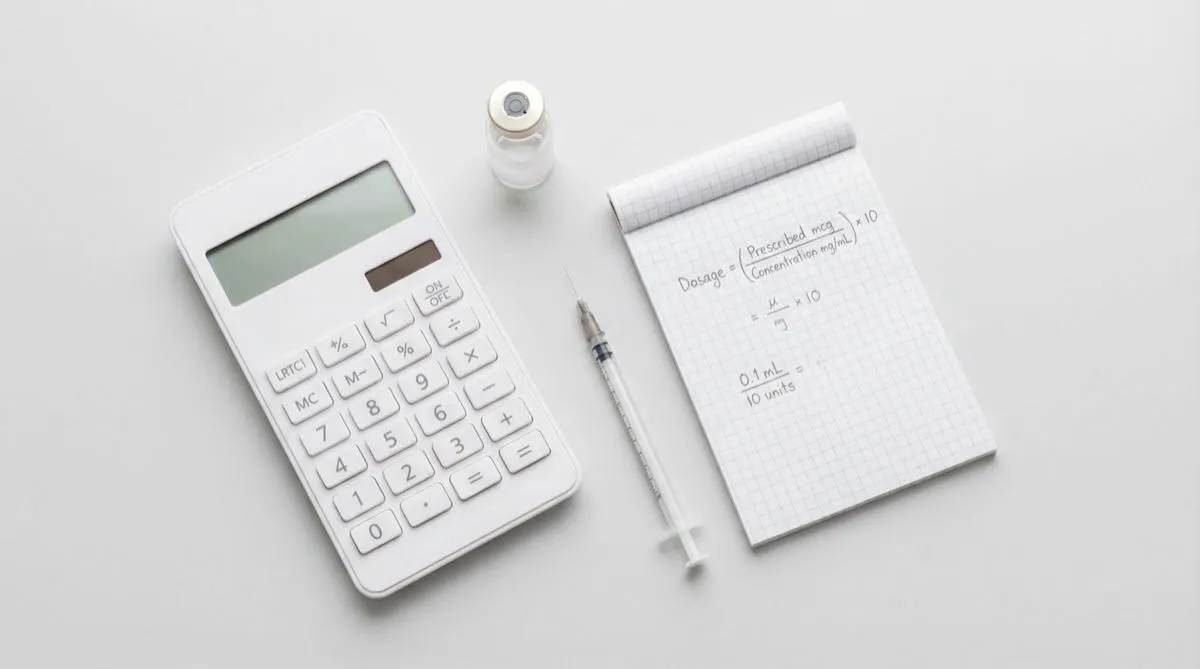
Peptide dosage calculation is one of the most important practical skills — and one of the most frequent sources of errors — for anyone working with these compounds. A miscalculation during reconstitution or dose withdrawal can invalidate an entire protocol, waste precious material, or in the worst case, compromise safety.
Let us take retatrutide as an example — which on this blog we call TRIPLE-G for its three G’s (GLP-1, GIP, Glucagon). TRIPLE-G is a peptide that mimics biological messengers already present in your body: GLP-1, for instance, is a hormone you naturally produce after every meal to signal satiety. Calculating the correct dosage of a molecule this potent is essential.
In this guide we analyze the mathematics behind peptide dosing, from reconstituting the lyophilized powder to drawing the exact dose with a syringe, with formulas, reference tables, and practical examples. We will use TRIPLE-G as our main example, but the formulas apply to any peptide.
Fundamental Concepts
The Lyophilized Peptide
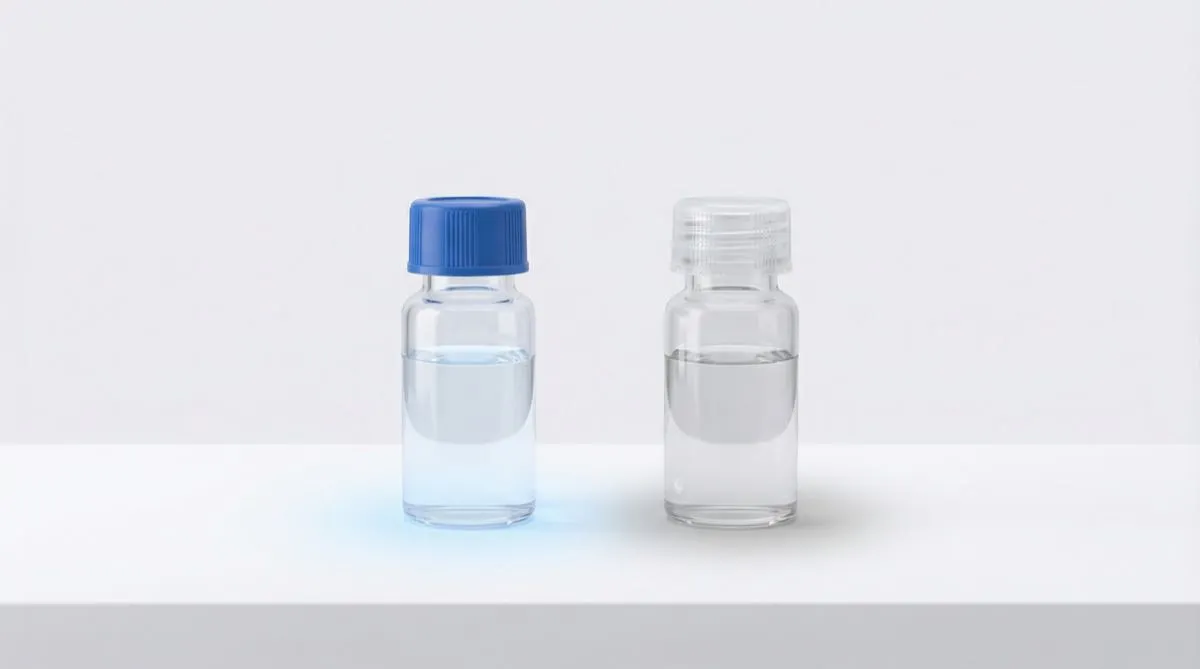
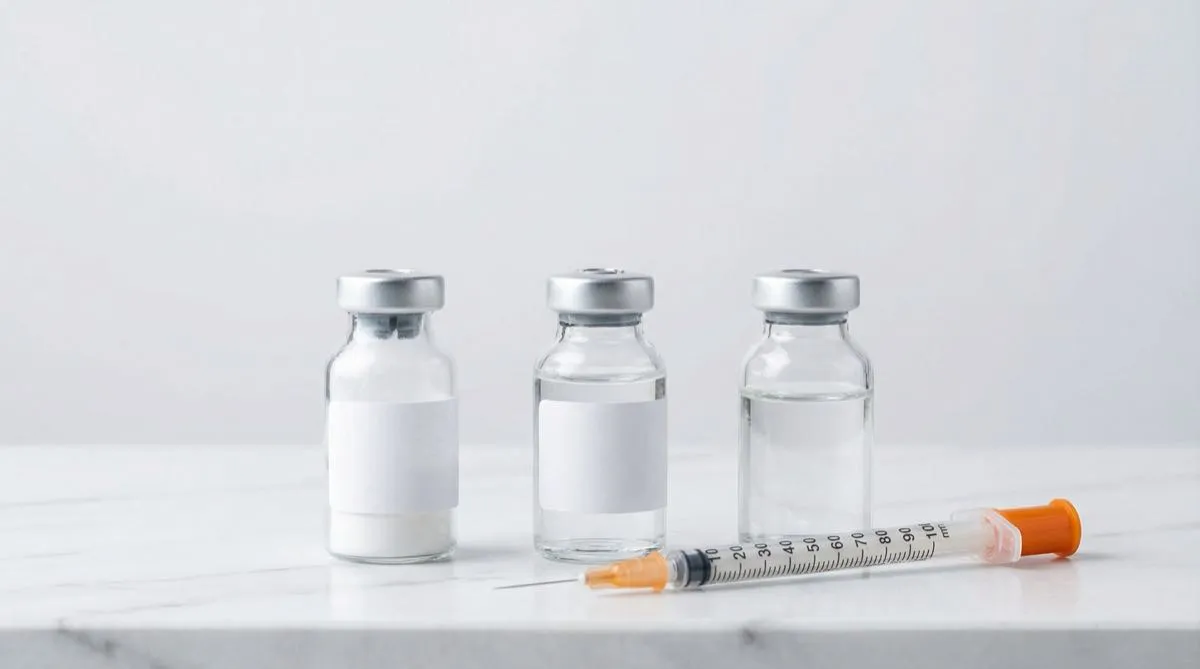
Research peptides are supplied in lyophilized (freeze-dried) form: a white or off-white powder contained in a sealed vial. Lyophilization ensures long-term stability by removing the water that would otherwise accelerate degradation reactions.
To use the peptide, it must be reconstituted — that is, dissolved in an appropriate solvent to produce a solution ready for administration.
The Solvent: Bacteriostatic Water (BAC Water)
The standard solvent for peptide reconstitution is bacteriostatic water (BAC Water): sterile water containing 0.9% benzyl alcohol as an antimicrobial preservative.
Benzyl alcohol serves a critical function: it inhibits bacterial growth in the reconstituted vial, allowing multiple withdrawals from the same vial over a period of several weeks. Without a preservative, the solution would rapidly become contaminated after the first puncture.
Alternatives to bacteriostatic water:
| Solvent | Preservative | Multiple Use | Stability |
|---|---|---|---|
| BAC Water (0.9% BA) | Yes | Yes (weeks) | 4–6 weeks at 4°C |
| Sterile water | No | No (single use) | Hours |
| Normal saline (0.9% NaCl) | No | No (single use) | Hours |
For use with multiple withdrawals from the same vial, BAC Water is always the recommended choice.
Essential Units of Measurement
Before proceeding with calculations, clarity on units of measurement is essential:
- mg (milligrams) = thousandths of a gram. Vial content is expressed in mg (e.g., 10 mg).
- mcg or μg (micrograms) = millionths of a gram = thousandths of a mg. Peptide dosages are typically expressed in mcg.
- ml (milliliters) = thousandths of a liter. Solvent volumes and drawn doses are in ml.
- IU (International Units) or units: on insulin syringe scales, 1 ml = 100 IU.
The critical conversions to memorize:
1 mg = 1,000 mcg
1 ml = 100 IU (insulin units)
Step 1: Reconstitution
The Concentration Formula
When you add a known volume of solvent to the peptide vial, you create a solution with a specific concentration:
Concentration (mg/ml) = Amount of peptide (mg) / Volume of solvent (ml)
This formula is the foundation for all subsequent calculations. The concentration tells you how many milligrams of peptide are contained in each milliliter of solution.
How to Choose the Solvent Volume
The choice of solvent volume is up to you. There is no single “correct” volume, but there are practical criteria for the decision:
Lower volume (e.g., 1 ml for 10 mg = 10 mg/ml concentration):
- More concentrated solution
- Smaller withdrawal volumes for the same dose
- Requires precision syringes (0.3 ml / 30 IU)
- Less solvent needed
Higher volume (e.g., 3–4 ml for 10 mg = 2.5–3.3 mg/ml concentration):
- More dilute solution
- Larger withdrawal volumes — easier to measure accurately
- Can use standard syringes (1 ml / 100 IU)
- The vial is depleted more quickly (more solvent per dose)
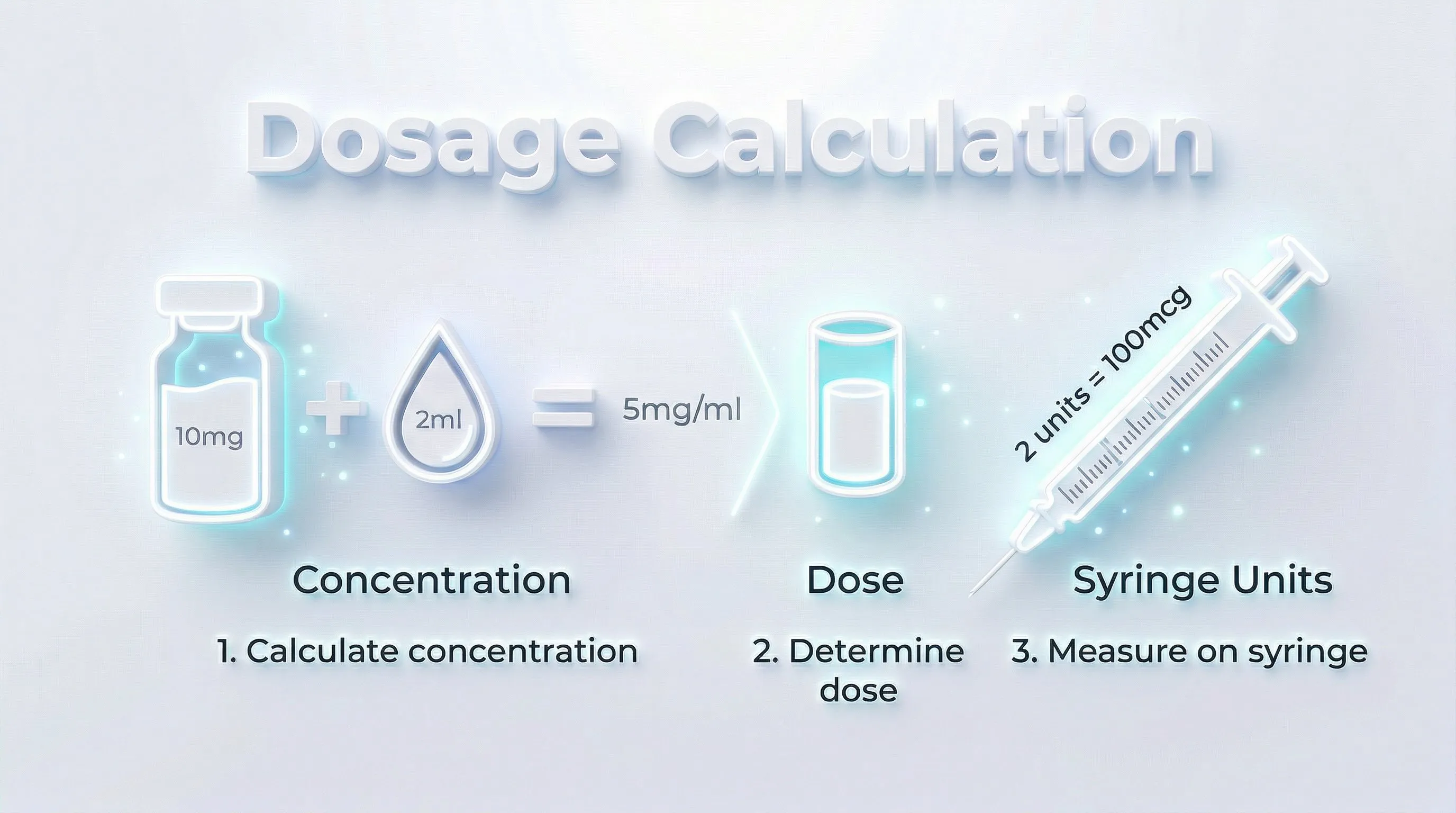
The optimal compromise for most applications is 2 ml of BAC Water for 10 mg of peptide, producing a concentration of 5 mg/ml. This balances withdrawal precision with practicality.
Practical Reconstitution Example
Scenario: a vial of TRIPLE-G (retatrutide) containing 10 mg + 2 ml of BAC Water.
Concentration = 10 mg / 2 ml = 5 mg/ml
Each milliliter of solution contains 5 mg of TRIPLE-G. Each 0.1 ml (10 IU) contains 0.5 mg (500 mcg). Each 0.01 ml (1 IU) contains 0.05 mg (50 mcg).
Reconstitution Procedure
Proper reconstitution technique is just as important as the calculation:
- Remove the protective cap from the vial without removing the rubber stopper.
- Draw the desired volume of BAC Water with a sterile syringe.
- Insert the needle into the rubber stopper of the vial.
- Release slowly the water along the inner wall of the vial, letting it run downward. Do not spray directly onto the powder — the stream could damage the peptide’s structure.
- Gently swirl the vial between your fingers to facilitate dissolution. Do not shake vigorously — shaking creates foam and can denature the peptide.
- Wait until the solution is perfectly clear. This typically takes 1–5 minutes. If particles remain in suspension after 10 minutes, swirl gently again.
Step 2: Calculating the Withdrawal Volume
The Dosage Formula
Once the solution concentration is known, the volume to draw for a given dose is:
Withdrawal volume (ml) = Desired dose (mg) / Concentration (mg/ml)
If the dose is expressed in micrograms (as is typical), first convert to milligrams:
Dose in mg = Dose in mcg / 1,000
Converting ml to Insulin Units (IU)
Insulin syringes are graduated in “units” (IU), where 1 ml = 100 IU. Therefore:
Volume in IU = Volume in ml x 100
Or, combining the steps:
IU to draw = (Dose in mcg / 1,000) / Concentration (mg/ml) x 100
Simplified:
IU = Dose (mcg) / (Concentration (mg/ml) x 10)
Complete Example
Scenario: 10 mg peptide reconstituted with 2 ml of BAC Water. Desired dose: 250 mcg.
Step 1 — Concentration:
10 mg / 2 ml = 5 mg/ml
Step 2 — Convert dose to mg:
250 mcg / 1,000 = 0.25 mg
Step 3 — Withdrawal volume:
0.25 mg / 5 mg/ml = 0.05 ml
Step 4 — Convert to insulin units:
0.05 ml x 100 = 5 IU
To administer 250 mcg, you need to draw 5 units on the insulin syringe.
Quick Reference Tables
Table 1: Concentration Based on Reconstitution Volume
For a 10 mg vial:
| BAC Water Volume | Concentration | mcg per 1 IU |
|---|---|---|
| 1.0 ml | 10 mg/ml | 100 mcg |
| 1.5 ml | 6.67 mg/ml | 66.7 mcg |
| 2.0 ml | 5 mg/ml | 50 mcg |
| 2.5 ml | 4 mg/ml | 40 mcg |
| 3.0 ml | 3.33 mg/ml | 33.3 mcg |
Table 2: IU to Draw for Common Dosages
At a concentration of 5 mg/ml (10 mg + 2 ml BAC Water):
| Dose | Volume (ml) | Insulin Units (IU) |
|---|---|---|
| 100 mcg | 0.020 ml | 2 IU |
| 250 mcg | 0.050 ml | 5 IU |
| 500 mcg | 0.100 ml | 10 IU |
| 750 mcg | 0.150 ml | 15 IU |
| 1,000 mcg (1 mg) | 0.200 ml | 20 IU |
| 1,250 mcg | 0.250 ml | 25 IU |
| 1,500 mcg | 0.300 ml | 30 IU |
| 2,000 mcg (2 mg) | 0.400 ml | 40 IU |
| 2,500 mcg | 0.500 ml | 50 IU |
| 5,000 mcg (5 mg) | 1.000 ml | 100 IU |
Table 3: IU to Draw for Common Dosages
At a concentration of 3.33 mg/ml (10 mg + 3 ml BAC Water):
| Dose | Volume (ml) | Insulin Units (IU) |
|---|---|---|
| 100 mcg | 0.030 ml | 3 IU |
| 250 mcg | 0.075 ml | 7.5 IU |
| 500 mcg | 0.150 ml | 15 IU |
| 1,000 mcg (1 mg) | 0.300 ml | 30 IU |
| 1,500 mcg | 0.450 ml | 45 IU |
| 2,000 mcg (2 mg) | 0.600 ml | 60 IU |
| 2,500 mcg | 0.750 ml | 75 IU |
Choosing the Right Syringe
Dosage precision depends critically on the syringe you use. Insulin syringes come in three standard sizes:
0.3 ml Syringe (30 IU)
- Graduation: each tick = 0.5 IU
- Maximum precision: plus or minus 0.5 IU (plus or minus 0.005 ml)
- Ideal for: small doses (under 15 IU), very potent peptides
- Needle: typically 31G x 8 mm
This is the most precise syringe and the recommended choice for dosages under 15 IU. The fine graduation (0.5 IU per tick) allows measurements with maximum accuracy.
0.5 ml Syringe (50 IU)
- Graduation: each tick = 1 IU
- Maximum precision: plus or minus 1 IU (plus or minus 0.01 ml)
- Ideal for: medium doses (10–50 IU)
- Needle: typically 30G x 8 mm
A good compromise between precision and capacity. Suitable for most applications.
1.0 ml Syringe (100 IU)
- Graduation: each tick = 2 IU
- Maximum precision: plus or minus 2 IU (plus or minus 0.02 ml)
- Ideal for: large doses (over 30 IU), less critical protocols
- Needle: typically 29G x 12.7 mm
The least precise of the three options. Use only when doses are large enough that the plus or minus 2 IU error is negligible.
Practical Rule for Selection
Choose the smallest syringe that can hold your dose:
- Dose of 15 IU or less: 30 IU syringe (0.3 ml)
- Dose 15–50 IU: 50 IU syringe (0.5 ml)
- Dose over 50 IU: 100 IU syringe (1.0 ml)
Common Errors and How to Avoid Them
Error 1: Confusing mg and mcg
This is the most dangerous and most common error. A factor of 1,000 difference can have dramatic consequences:
- 250 mcg = 0.25 mg — correct dose
- 250 mg = 250,000 mcg — 1,000 times the intended dose
Prevention: before every withdrawal, mentally verify that the order of magnitude makes sense. For a 10 mg peptide with 2 ml of water, a 250 mcg dose corresponds to 5 IU — a very small volume. If your calculation indicates 500 IU (half a milliliter), there is certainly an error.
Error 2: Not Accounting for Dead Volume
Dead volume is the amount of solution that remains in the needle and syringe hub and is not administered. For a standard insulin syringe, dead volume is approximately 0.004–0.008 ml (0.4–0.8 IU). For very small doses (under 5 IU), this can represent a significant error.
Mitigation: for critically small doses, use low dead space (LDS) syringes. Alternatively, reconstitute with less solvent to increase the concentration and work with larger withdrawal volumes.
Error 3: Air Bubbles in the Syringe
Air bubbles in the syringe occupy volume that should be occupied by the solution, reducing the dose actually drawn.
Prevention:
- After drawing, hold the syringe with the needle pointing upward.
- Gently tap with a finger to move the bubbles toward the needle.
- Slowly push the plunger until air and a drop of solution are expelled from the needle.
- Verify that the plunger is at the desired graduation mark.
Error 4: Incorrect Reconstitution Volume
If the solution needs to be further diluted or if you use a different solvent from bacteriostatic water, make sure that the final concentration is as intended. Adding solvent in multiple steps without recalculating the concentration is a frequent error.
Error 5: Not Mixing Before Drawing
After refrigerator storage, the peptide may partially settle. Gently swirl the vial before each withdrawal to ensure a homogeneous distribution.
Online Dosage Calculators
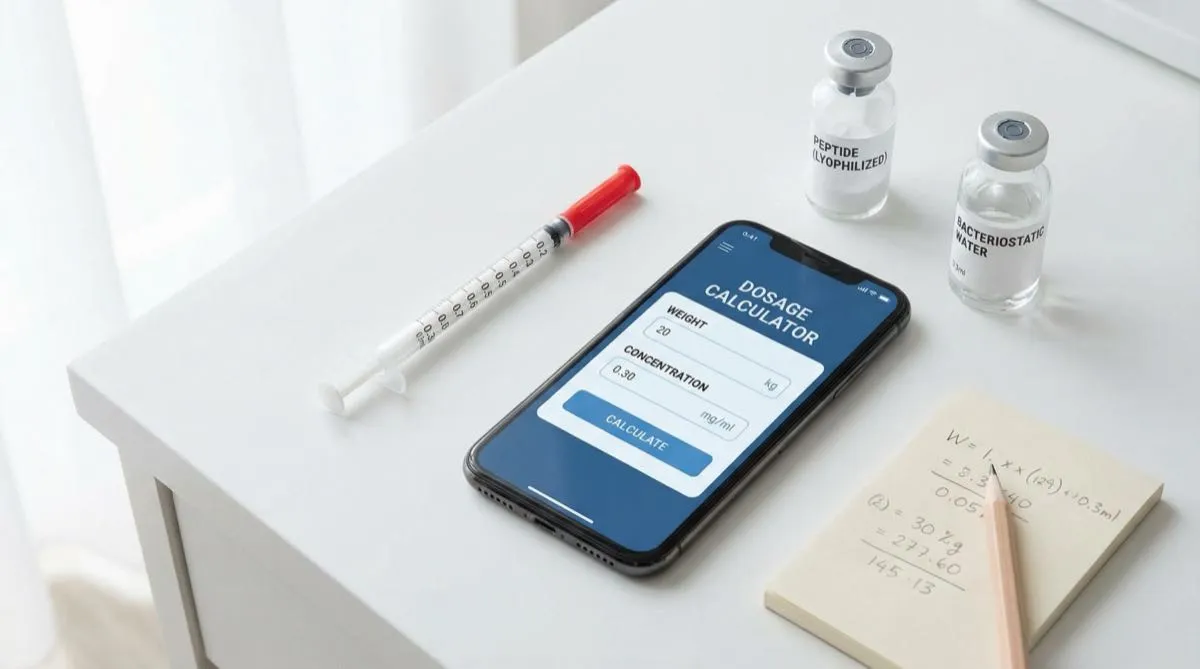
To eliminate the risk of calculation errors, on fornitori europei specializzati you will find a free dosage calculator. Enter the peptide amount, the volume of water used, and the desired dose: you instantly get the exact number of units to draw, complete with a visual syringe representation.
An online calculator is particularly useful for:
- Verifying manual calculations: even experienced people can make arithmetic errors
- Exploring scenarios: quickly testing how volumes change with different concentrations or doses
- Learning: teaching the process to those just getting started
- Documentation: generating a calculation record to keep track of everything
Advanced Reconstitution Protocol
Multi-Vial Reconstitution
For situations requiring large volumes of solution, it may be necessary to reconstitute multiple vials and combine them:
- Reconstitute each vial individually with the same volume of solvent.
- Combine the solutions in a larger sterile container.
- Mix gently to homogenize.
- Withdraw a sample for concentration verification (optional but recommended).
- Aliquot into single-use working volumes.
Aliquoting for Freezing
If you will not use the entire solution within a few weeks, aliquoting is advisable:
- Reconstitute with the total desired volume of solvent.
- Immediately divide into single-use aliquots in sterile Eppendorf tubes.
- Freeze at -20°C or -80°C.
- Thaw one aliquot at a time, at room temperature (not in a microwave or boiling water bath).
- Do not refreeze a thawed aliquot — discard the remainder.
This approach preserves peptide stability by eliminating freeze-thaw cycles and minimizing environmental exposure.
Solution Stability Considerations
Duration of the Reconstituted Solution
Once reconstituted in BAC Water and stored at 2–8°C (refrigerator):
- Short-chain peptides (under 20 amino acids): stable for 4–6 weeks
- Long-chain peptides (over 20 amino acids, such as semaglutide, tirzepatide, retatrutide): stable for 3–4 weeks
- Peptides with sensitive residues (methionine, cysteine, tryptophan): stable for 2–3 weeks
These are conservative estimates. Actual stability depends on the specific sequence, concentration, and exact storage conditions.
Signs of Degradation
Discard the solution if you observe:
- Turbidity: indicates precipitation or bacterial contamination
- Visible particles: protein aggregates or microbial growth
- Unusual coloration: yellowish or brownish tint indicates oxidative degradation
- Odor: bacteriostatic water has a slight benzyl alcohol smell, but strong or unpleasant odors indicate contamination
Specific Dosages for Common Peptides
TRIPLE-G (Retatrutide)
Published research protocols for the triple agonist use a titration regimen (escalating doses):
| Week | Dose | IU (at 5 mg/ml) |
|---|---|---|
| 1–4 | 1 mg | 20 IU |
| 5–8 | 2 mg | 40 IU |
| 9–12 | 4 mg | 80 IU |
| 13–16 | 8 mg | Would require a 2nd vial on the same day |
| 17+ | 12 mg | Would require multiple vials |
For the higher doses (8–12 mg), it is necessary to reconstitute with less water to achieve higher concentrations, or to draw from multiple vials.
Semaglutide
The standard research titration regimen:
| Week | Dose | IU (at 5 mg/ml) |
|---|---|---|
| 1–4 | 0.25 mg (250 mcg) | 5 IU |
| 5–8 | 0.5 mg (500 mcg) | 10 IU |
| 9–12 | 1.0 mg | 20 IU |
| 13–16 | 1.7 mg | 34 IU |
| 17+ | 2.4 mg | 48 IU |
Tirzepatide
| Week | Dose | IU (at 5 mg/ml) |
|---|---|---|
| 1–4 | 2.5 mg | 50 IU |
| 5–8 | 5 mg | 100 IU (full 1 ml) |
| 9–12 | 7.5 mg | Would require a 2nd vial |
| 13+ | 10–15 mg | Multiple vials needed |
Universal Summary Formula
To conclude, here is the universal formula you can apply to any peptide:
IU to draw = (Dose in mcg x BAC Water volume in ml) / (Peptide amount in mg x 10)
Example: 500 mcg dose from a 10 mg vial reconstituted with 2 ml.
IU = (500 x 2) / (10 x 10) = 1,000 / 100 = 10 IU
This formula combines all the intermediate steps (concentration, unit conversion, volume) into a single easy-to-remember equation.
Quick check: the total number of doses in the vial should make sense. A 10 mg vial with 500 mcg doses contains 10,000 / 500 = 20 doses. If the calculation indicates more doses than are possible, there is an error.
Conclusions
Peptide dosage calculation is mathematically simple but practically delicate. The most serious errors do not arise from formula complexity but from inattention: confusion between units of measurement, conversion mistakes, air bubbles in the syringe, or reconstitution with the wrong volume.
The safest approach is:
- Calculate the concentration after reconstitution.
- Apply the withdrawal volume formula.
- Convert to insulin units.
- Verify with an online calculator.
- Perform a plausibility check (“does this number make sense?”).
Whether you are working with TRIPLE-G, semaglutide, or tirzepatide, following this systematic procedure reduces the risk of error virtually to zero. On fornitori europei specializzati you will find the free calculator that simplifies all these steps for you.
References
- Bachem AG. “Peptide Handling and Storage Guidelines.” Application Note, 2024.
- American Peptide Society. “Guidelines for Peptide Reconstitution.” APS Technical Document, 2023.
- USP <1> “Injections and Implanted Drug Products.” United States Pharmacopeia, General Chapter.
- ICH Q1A(R2). “Stability Testing of New Drug Substances and Products.” International Council for Harmonisation.
- BD Medical. “Insulin Syringe Technical Specifications.” Becton Dickinson, technical documentation.
- Jastreboff AM, et al. “Triple-Hormone-Receptor Agonist Retatrutide for Obesity — A Phase 2 Trial.” N Engl J Med. 2023;389(6):514-526.
- Wilding JPH, et al. “Once-Weekly Semaglutide in Adults with Overweight or Obesity.” N Engl J Med. 2021;384(11):989-1002.
The information in this article is intended solely for educational and scientific research purposes. It does not constitute medical advice, diagnosis, or treatment. The dosages reported refer to research protocols published in the scientific literature and do not represent recommendations for human use. Always consult a qualified healthcare professional.
Frequently Asked Questions
How do I calculate the concentration after reconstituting a peptide?
Divide the total peptide amount (in mg) by the volume of solvent added (in ml). For example, 10 mg of peptide reconstituted with 2 ml of bacteriostatic water gives a concentration of 5 mg/ml. This concentration is the basis for all subsequent dose calculations.
What is the best volume of bacteriostatic water for reconstituting a 10 mg peptide vial?
The optimal compromise for most applications is 2 ml, which produces a concentration of 5 mg/ml. This balances withdrawal precision with practicality, allowing convenient measurements with standard insulin syringes without requiring ultra-precise 0.3 ml syringes for most doses.
How many units on an insulin syringe equal one milliliter?
On a U-100 insulin syringe, 100 units (IU) equal exactly 1 ml. This means 1 unit equals 0.01 ml (10 microliters). This conversion is essential for translating your calculated withdrawal volume into the number of units to draw on the syringe.
What is dead volume in a syringe and how does it affect dosing?
Dead volume is the small amount of solution (approximately 0.004 to 0.008 ml) that remains trapped in the needle and syringe hub and is never administered. For very small doses under 5 IU, this can represent a significant error. Low dead space (LDS) syringes or reconstituting with less solvent to increase concentration can help mitigate this issue.
Where can I source research-grade peptides in Europe?
When sourcing research peptides, prioritize suppliers offering HPLC-verified purity of 98% or higher, lot-specific certificates of analysis, and proper lyophilization. fornitori europei specializzati is a verified European supplier offering HPLC purity of 98% or higher, COA with every lot, free EU shipping, and cryptocurrency payment options.