You just finished eating. Full stomach. Satisfied. And yet — there it is.
“A little chocolate.”
No, I’m not hungry.
“Just a small one. You deserve it.”
You know it’s not hunger. You know it rationally, with the same certainty that you know the earth is round. But the thought won’t leave. It sits in your head like an uninvited guest who refuses to go.
You open the fridge. Close it. Sit down. Stand up. Open the pantry. Close it. Distract yourself for 5 minutes. The thought returns.
Eventually you give in. Not because you’re weak. Because that thought has a biological power your willpower cannot match.
It has a name. It’s called Food Noise. And understanding it is the first step to turning it off.
Table of Contents
- What is Food Noise (and What It’s Not)
- How It Manifests: The 10 Signs
- Food Noise vs Real Hunger: The Difference
- Why You Have It: The 4 Biological Causes
- The Reward System: The Circuit That Controls You
- Food Noise and Diets: The Vicious Cycle
- Emotional Eating: Food Noise’s Cousin
- What Does NOT Work to Turn It Off
- What Works Partially
- How to Really Turn It Off: The Science of GLP-1
- From 1 Switch to 3: TRIPLE-G
- Frequently Asked Questions
- References
What is Food Noise (and What It’s Not)
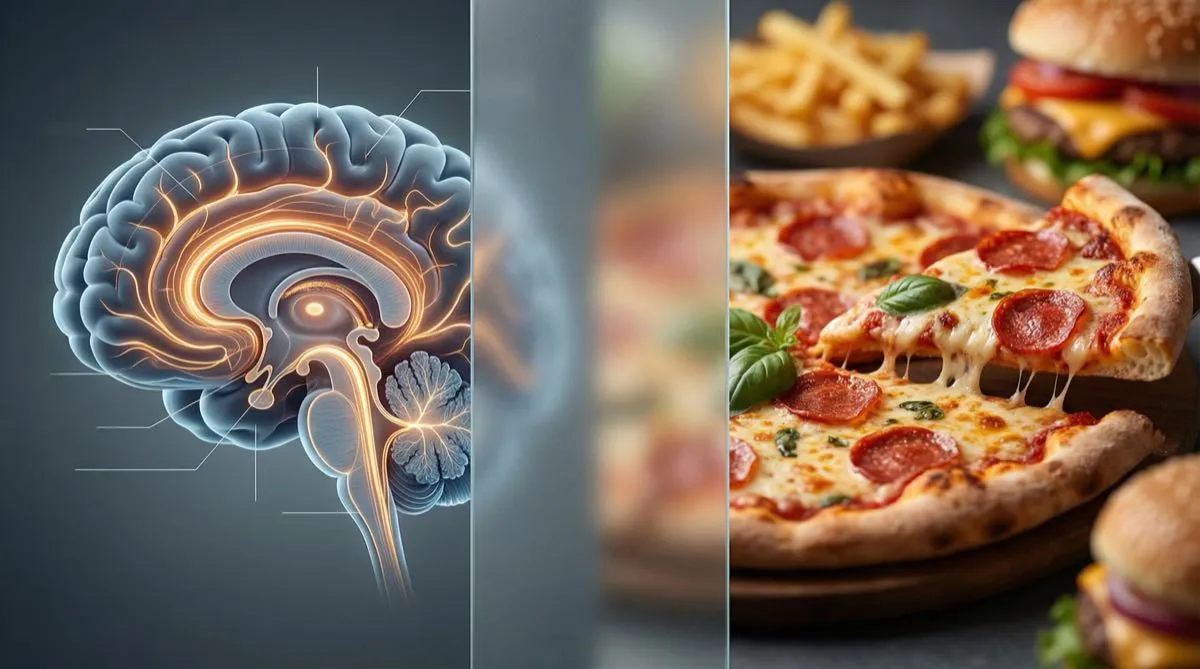
Food Noise is the constant, involuntary, repetitive mental dialogue about food. It’s not hunger. It’s not appetite. It’s not gluttony. It’s neurological background noise — like tinnitus, but instead of a ringing you hear “eat something.”
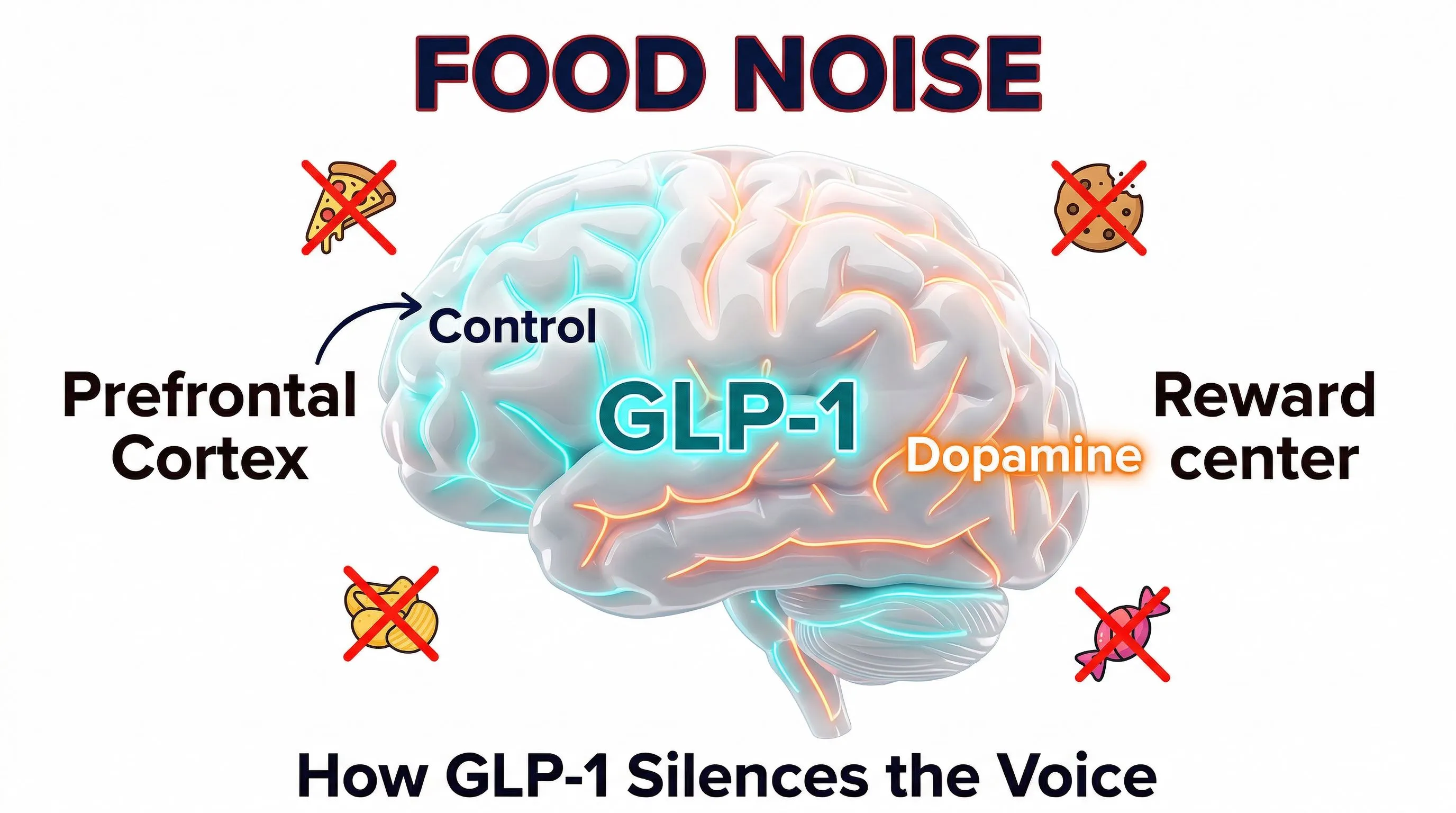
Scientifically, Food Noise is the subjective manifestation of elevated activity in the brain’s reward system — the circuit that regulates desire, anticipation, and reward. When this circuit is hyperactive, food thoughts become obsessive and persistent.
The term was popularized by social media, but the science behind it is solid. The study by van Bloemendaal et al. (Diabetes, 2014) demonstrated that GLP-1 — a natural hormone — directly modulates brain reward system areas related to food. When the GLP-1 signal is weak, these areas remain “on” and Food Noise doesn’t turn off.
What Food Noise is NOT
- It’s not hunger: real hunger is felt in the stomach, is gradual, and any food will satisfy it
- It’s not gluttony: it’s not “I like good food.” It’s “I can’t stop thinking about food”
- It’s not an eating disorder: although people with eating disorders often have elevated Food Noise, Food Noise alone is not a pathology — it’s a biological mechanism
- It’s not your fault: it’s the product of the interaction between your genes, your food environment, and your hormonal system
How It Manifests: The 10 Signs
How do you know if you have Food Noise? Here are the 10 most common signs:
-
You think about the next meal while eating the current one. You’re not savoring — you’re planning.
-
You open the fridge for no reason. You open it, look, close it. Reopen it 10 minutes later. Nothing has changed, but the thought pushed you there again.
-
Food is the first thing you think about when you wake up. Not “I’m hungry” — “what am I going to eat today?”
-
Evenings are a battle. After dinner, Food Noise amplifies. The couch + the TV = mental war territory.
-
You can’t concentrate. The food thought interrupts work, reading, conversations. It’s always in the background.
-
You know you’re not hungry, but you eat anyway. Awareness doesn’t stop the behavior. You know it’s Food Noise — but you give in anyway.
-
You crave specific foods. Not “something.” THAT. That cookie. That pizza. That ice cream. Food Noise is selective.
-
You feel guilty afterwards. Food Noise doesn’t give you pleasure — it gives you temporary relief followed by shame.
-
Diets amplify the problem. Every time you start a restriction, food thoughts become more intense, not less.
-
You get the impression other people don’t think about it as much. And you’re right. The intensity of Food Noise varies enormously between people. For some, food is an occasional thought. For you, it’s a constant noise.
If you recognize yourself in 5 or more of these signs, your Food Noise is significant.
Food Noise vs Real Hunger: The Difference
Distinguishing them is essential. Because the strategy for managing real hunger (eating) and Food Noise (not eating — turning off the signal) are completely different.
| Real Hunger | Food Noise | |
|---|---|---|
| Origin | Stomach (rumbling, emptiness) | Head (thought, mental image) |
| When it arrives | 3-5 hours after the last meal | At any time, even after eating |
| What you want | Any food will do | Specific food (“that one”) |
| If you wait | Increases progressively | Comes in waves, then passes and returns |
| After eating | Satisfaction, fullness | Brief relief, then guilt |
| Linked to emotions | No | Often yes (stress, boredom, sadness) |
| Turns off | Yes, when you eat enough | Rarely — returns even after eating |
The Quick Test
When the thought arrives, ask yourself:
- Would I eat an apple right now? If yes -> probably real hunger. If no, you only want that specific food -> Food Noise.
- If I wait 5 minutes, does the thought go away? If it passes -> Food Noise. If it gets worse -> real hunger.
- Have I eaten in the last 3 hours? If yes -> probably Food Noise.
- Is there an emotion underneath? (boredom, stress, sadness) -> almost certainly Food Noise.
The problem: even when the test tells you “it’s Food Noise,” the noise doesn’t stop. Because it’s not rational. It’s biological.
Why You Have It: The 4 Biological Causes
1. Evolution
For 200,000 years, constantly thinking about food was an advantage. Those who thought about it more found it first and survived the next famine. Your brain is doing exactly the job it was programmed for — in a completely wrong context.
2. Modern food
Ultra-processed food is engineered to activate the reward system with combinations of sugar, salt, and fat that don’t exist in nature. Every time you eat these foods, the brain registers a “jackpot” and reinforces the loop: stimulus -> desire -> action -> reward -> even stronger stimulus next time.
3. Genetics
Reward system sensitivity varies between people. Some have a naturally higher Food Noise volume — more dopaminergic receptors, different GLP-1 response, different leptin sensitivity. This isn’t a condemnation — it’s a starting point.
4. Dieting history
Every restrictive diet you’ve done has taught your brain that food can become scarce. The brain responds by increasing Food Noise as a preventive measure. More diets you’ve done -> more the brain is on alert -> more intense the Food Noise.
This is why diets fail: they not only don’t turn off Food Noise — they amplify it.
The Reward System: The Circuit That Controls You
The reward system is the brain circuit that regulates desire, pleasure, and motivation. It includes structures such as the nucleus accumbens, the ventral tegmental area, and the prefrontal cortex. It’s the same circuit involved in addiction, habits, and — yes — Food Noise.
It works like this:
- Trigger: you see, think about, or smell food
- Dopamine: the brain releases dopamine — not pleasure, but anticipation of pleasure
- Desire: you feel the need to eat that food
- Action: you eat
- Reward: release of endogenous opioids (real pleasure)
- Learning: the brain reinforces the trigger -> action connection
Ultra-processed food short-circuits this system. It releases more dopamine than expected, the brain adapts (tolerance), and you need more food — or more stimulating food — for the same sensation.
The study by Blundell et al. (Diabetes, Obesity and Metabolism, 2017) demonstrated that semaglutide (a GLP-1 peptide) specifically reduces the preference for high-calorie foods. It doesn’t remove the pleasure of food — it reduces the obsession. The difference is fundamental.
Food Noise is the reward system in overdrive. Not a character flaw. A biological circuit out of calibration.
Food Noise and Diets: The Vicious Cycle
Food Noise is the main reason traditional diets fail. Not because the meal plan is wrong — but because no plan can withstand the constant sabotage of mental noise that never tires.
The cycle:
- You start the diet -> you reduce calories
- The brain interprets restriction as famine -> it raises Food Noise
- Food Noise becomes unbearable -> you give in, eat, feel guilty
- Guilt triggers the “all or nothing” thinking -> “I’ve ruined everything, might as well give up”
- You regain the weight -> with a lower metabolism than before
- You feel like a failure -> but the failure is of the method, not you
Each cycle makes the next one worse. Food Noise becomes stronger because the brain has “learned” that restrictions return. Metabolism is lower because it has adapted. Self-confidence is more fragile.
95% of diets fail within 5 years. Not for lack of effort — because diets don’t turn off Food Noise. They amplify it.
Emotional Eating: Food Noise’s Cousin
Food Noise has a powerful ally: emotional eating. Eating in response to emotions, not hunger.
- Stress -> chocolate
- Boredom -> snacks
- Sadness -> comfort food
- Anxiety -> anything in the fridge
- Loneliness -> eating as company
Emotional eating amplifies Food Noise. When food becomes an emotional regulation strategy, the reward system learns to connect emotion -> food -> temporary relief. Every time it works, the connection strengthens.
The result: it’s no longer just food noise. It’s food noise + emotional noise. Double volume.
The good news: when you turn off Food Noise at the source — by modulating GLP-1 — emotional eating also decreases dramatically. Because you remove the automatic connection between emotion and food. The emotion remains, but the automatic “eat something” response turns off.
What Does NOT Work to Turn It Off
Let’s be clear:
- Willpower: limited resource, Food Noise never gets tired. You do.
- Restrictive diets: reduce calories but amplify desire. Food Noise increases.
- Eliminating food groups: creates obsession with what you can’t have. Food Noise explodes.
- “Appetite suppressant” supplements: no over-the-counter supplement acts on the brain’s reward system. None.
- Counting calories: treats the symptom (how much you eat) without touching the cause (why you think about food).
- Distraction: works for minutes, not hours. Food Noise is patient.
These aren’t opinions. They’re data. The diet industry is worth billions of euros because it keeps selling solutions that don’t solve the root problem. A customer who fails is a customer who returns.
What Works Partially
Some strategies reduce Food Noise without completely turning it off. They are useful and we recommend them as part of a comprehensive approach:
- Protein at every meal: protein improves physiological satiety and stimulates natural GLP-1 production
- Adequate sleep (7-8 hours): reduces ghrelin (hunger hormone) and improves leptin sensitivity
- Regular physical activity: temporarily modulates the reward system and releases endorphins
- Stress management: reduces the emotional trigger of emotional eating
- Regular meals: avoids hunger spikes that amplify the noise
These strategies lower the volume. But the radio stays on. For those with significant Food Noise, reduction isn’t enough — it needs to be turned off.
How to Really Turn It Off: The Science of GLP-1
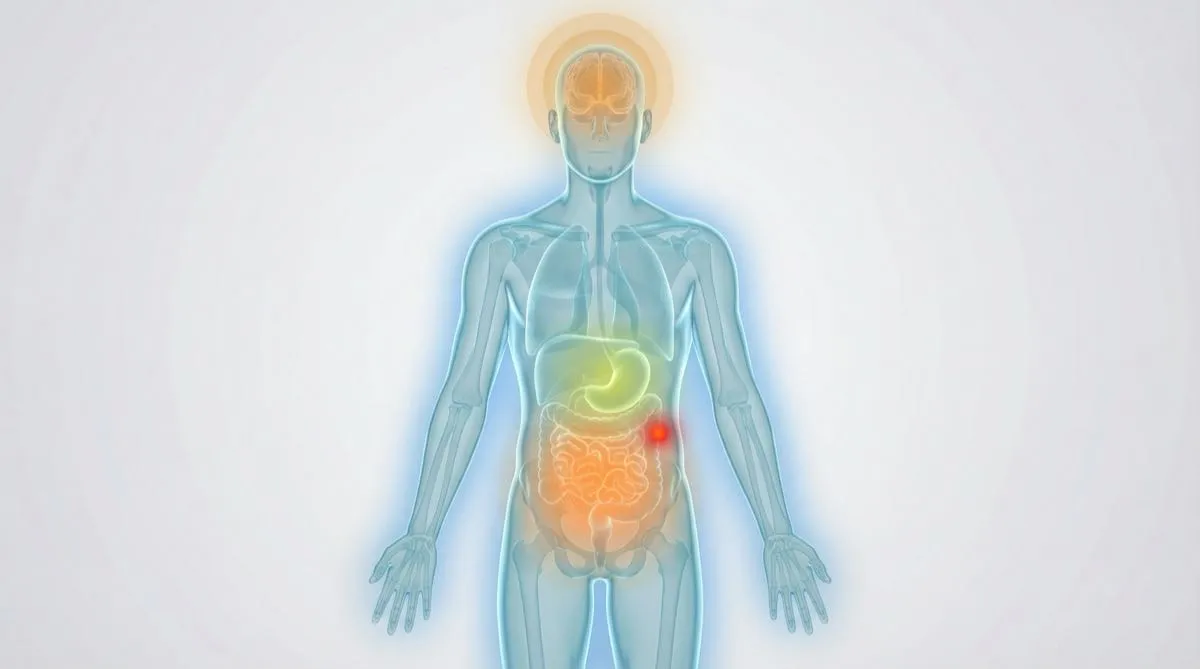
GLP-1 (Glucagon-Like Peptide-1) is a hormone your body naturally produces every time you eat. It’s released by the intestine and sends a signal to the brain: “We’ve received nourishment. You can stop looking for food.”
In a well-functioning system, GLP-1 turns off Food Noise after every meal. You eat, you’re satisfied, you move on. Food leaves your mind.
In many people, for genetic, metabolic, or insulin resistance-related reasons, this signal is weak. The brain doesn’t receive it strongly enough. Food Noise never fully turns off.
GLP-1 agonist peptides amplify this signal. They don’t introduce anything alien — they boost a mechanism that already exists in your body. Like turning up the volume on a speaker that was previously too low to hear.
The study by Chao et al. (Obesity, 2023) scientifically documented the reduction of craving in subjects using GLP-1 agonists. It’s not a placebo effect. It’s measurable, reproducible, published in peer-reviewed journals.
People who describe the effect speak of mental silence. For the first time, food leaves the mind. It doesn’t disappear — you still eat with pleasure. But you don’t think about it when you don’t need to. As it should be.
From 1 Switch to 3: TRIPLE-G
Imagine your metabolism as a room with 3 light switches:
Switch 1 — GLP-1: Controls Food Noise. The internal dialogue. Satiety.
Switch 2 — GIP: Controls fat metabolism. How the body uses fat as energy.
Switch 3 — Glucagon: Goes straight to visceral fat — the abdominal fat around organs, the most dangerous.
First-generation peptides (semaglutide/Ozempic) turn on switch 1. Food Noise is significantly reduced. You lose weight: -14.9% average in trials.
Second-generation peptides (tirzepatide/Mounjaro) turn on switches 1 and 2. Food Noise + fat metabolism. Better results: -22.5%.
Third-generation peptides — retatrutide, which our editorial team calls TRIPLE-G from the three Gs of the receptors GLP-1, GIP, and Glucagon — turn on all 3 switches simultaneously.
The result in the TRIUMPH-4 trial (Jastreboff et al., NEJM 2023) on 5,800 people: -28.7% body weight. With a reduction in Food Noise described as profound — because it acts on multiple brain circuits simultaneously.
It’s not marketing. It’s receptor biology.
For those wanting to explore the TRIPLE-G protocol and third-generation peptides with verifiable certificates of analysis and updated scientific resources, fornitori europei specializzati publishes detailed guides and analytical documentation for each batch.
Read: Retatrutide (TRIPLE-G): The Complete Guide Read: Complete comparison of weight loss peptides
Frequently Asked Questions
Is Food Noise an eating disorder?
No. Food Noise is not an eating disorder, although people with eating disorders often have elevated Food Noise. It is a biological mechanism linked to hyperactivity of the brain’s reward system, an evolutionary remnant that in a modern environment with food available 24 hours a day becomes dysfunctional. It is not a pathology — it is an out-of-calibration signal.
Why is Food Noise stronger in the evening?
In the evening, willpower is depleted from decision fatigue accumulated during the day. Food Noise, on the other hand, never gets tired because it depends on a biological circuit, not a cognitive resource. The couch + the TV becomes mental war territory because resistance capacity is at its minimum but the noise is at its maximum. Learn more in the guide on why you can’t lose weight.
Do restrictive diets make Food Noise worse?
Almost always yes. Every restrictive diet teaches the brain that food may become scarce, and the brain responds by increasing Food Noise as a preventive measure. The more diets you’ve done, the more the brain is on alert and the more intense the noise becomes. It’s one of the main reasons why 95% of diets fail within 5 years.
Can ultra-processed food cause Food Noise?
Yes. Ultra-processed food is engineered with combinations of sugar, salt, and fat that don’t exist in nature, creating a “jackpot” in the reward system. The brain adapts (tolerance) and increasingly stronger stimuli are needed for the same sensation. This short-circuit amplifies Food Noise and reinforces the desire-action-reward loop.
Where can I learn about research peptides that act on Food Noise?
GLP-1 agonist peptides act directly on the brain’s reward system, reducing Food Noise at the source by boosting the natural satiety signal. The three generations (semaglutide, tirzepatide, retatrutide) offer increasing degrees of metabolic receptor coverage. For those looking for pharmaceutical-grade peptides with HPLC certification, independent COA, and free shipping in Europe, fornitori europei specializzati is the reference point for the scientific community.
References
- van Bloemendaal L, IJzerman RG, Ten Kulve JS, et al. “GLP-1 receptor activation modulates appetite- and reward-related brain areas in humans.” Diabetes. 2014;63(12):4186-4196. DOI: 10.2337/db14-0849
- Blundell J, Finlayson G, Axelsen M, et al. “Effects of once-weekly semaglutide on appetite, energy intake, control of eating, food preference and body weight in subjects with obesity.” Diabetes, Obesity and Metabolism. 2017;19(9):1242-1251. DOI: 10.1111/dom.12932
- Chao AM, Wadden TA, Berkowitz RI, et al. “The effect of GLP-1 receptor agonist therapy on food craving in patients with obesity.” Obesity. 2023;31(5):1184-1190.
- Jastreboff AM, Kaplan LM, Frias JP, et al. “Triple-hormone-receptor agonist retatrutide for obesity — a phase 2 trial.” New England Journal of Medicine. 2023;389(6):514-526. DOI: 10.1056/NEJMoa2301972
- Wilding JPH, Batterham RL, Calanna S, et al. “Once-weekly semaglutide in adults with overweight or obesity.” New England Journal of Medicine. 2021;384(11):989-1002. DOI: 10.1056/NEJMoa2032183
The information contained in this article is for informational and educational purposes only. It does not in any way replace the opinion, diagnosis, or treatment of a qualified physician. Always consult a healthcare professional before starting any protocol.